Browse Author

Bryan

Day 3: Sarajevo, Bosnia Herzegovina 

I slept really well, whereas Kuniko was awoken in the middle of the night by some people talking loudly in another room in the hotel. The time was nearly 3 am, and these people had come back from whatever event/party they had attended and the high ceilings were carrying their voices throughout the building. Kuniko actually went out of our room to track down the source. Eventually around 4 am one of them left and things got quiet. I just lay there – oblivious, unconscious, unhelpful.

Our hotel offered breakfast and we went to partake at 7 am, and it was quite a spread. Considering the size of the hotel they had lots of different items, the usual stuff and also some burek, rolls, plenty of yogurts, hot eggs, and so we were looking good. The automatic espresso machine made a pretty good cappuccino, but we noticed only afterwards that the empty cup should be placed on the left – we lost some precious coffee thanks to our lack of attention to the sign. Once a cook came in to check on things and get her own coffee, and she seemed really friendly although we couldn’t communicate very well.

Afterwards we set out to walk through old town and do some sightseeing with fewer people around. This early sightseeing was our strategy whenever we travel – but even in the morning the sun was quite hot, and we had to stick to walking in the shade only.

We did a bit of exploring, beyond to the old town to climb a hill overlooking part of the city, to see a memorial graveyard. We tried to visit a mosque that look quite beautiful, but the gates were firmly closed at the early hour. The old brewery in town looked interesting online but was all shut down when we went past. Other than those fails we had success seeing other things. At 9 am we went into the big city office that was renovated after a fire in the 1990s. The entrance hall was dramatically lit up with vivid colors and they had movie scores playing from some hidden speakers – it felt a little like Instagram bait. But the rooms upstairs were dedicated to documenting the war crimes of the Yugoslavian war. They were fairly graphic (by design) and I think the showy entrance was probably a good strategy to get more young people in there to learn about their history. 

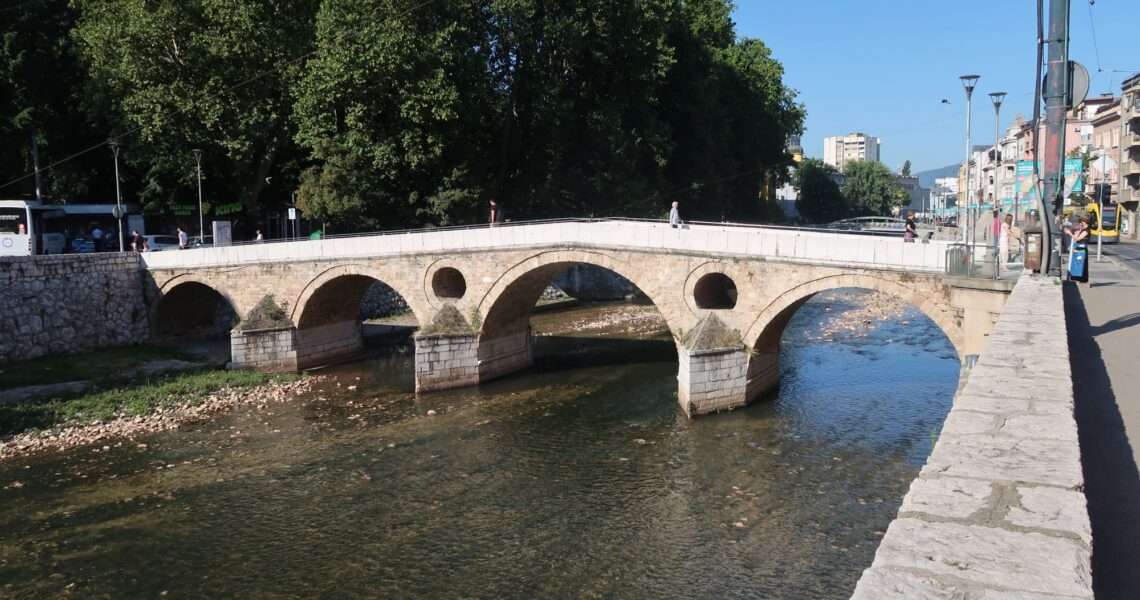
Afterwards we walked along the river (which was flowing more freely than yesterday) towards the Academy of Fine Arts building in the west part of town. Along the way we tried to stay to the shady side of the street. We checked out the Latin Bridge – hard to believe this historic bridge was so simple. We had unknowingly walked over it the night before.

We also passed some kind of military building – outside a large squad of soldiers was in the process of lining up – maybe going on duty. Across from the Fine Arts building was an interesting artistic bridge that looked like it was doing a loop. Artistic and eye-catching!

Since we had already come across most of the city we decided to make a run to the train station in the northwest to buy tickets for tomorrow’s train to Mostar. Usually I like to get those lined up online but their website had said that online sales were unavailable at the moment (the message stayed the same for four months before we arrived).We didn’t want to miss out on the train so we thought we’d lock down the tickets today.

It was a fair walk in the heat, about 25 minutes, and even trying to stay in the shade we were starting to get sweaty. We spotted some markets on the way, and some interesting building architecture. Once we got to the train station there was no shade anywhere, so we had to cross a big hot parking lot in the sun. Luckily we had brought sunscreen.

We approached the station and it appeared empty. There were just two or three cars in the giant lot, and not what we expected in the capital city of the country. Inside was also empty – I was reminded of exploring ruins in the Fallout video games. There was someone sitting in the ticket office, but when we asked about tickets she said that we should come early tomorrow and buy them then. So our trip to the station was sort of a bust. As soon as we walked away from the station we saw the ticket agent and her friend walking away – apparently to go to lunch. I can’t help thinking that we could have gotten tickets if lunchtime hadn’t been coming up. 

On our way back we stopped in a little convenience store to get some water. The store’s name was “Konsume” which is a very direct name for a retail outlet. They took credit cards, so we didn’t have to use any of our precious BAM. From there we stopped in at the giant SCC (Sarajevo City Center) which was an air conditioned shopping mall. Besides cooling down we bought some snacks for the train trip the next day, and some more water. We also hit another ATM, figuring that we should have cash on hand for train tickets just in case.

As we got closer to our hotel I looked up a wine bar that I wanted to try, and even with the GPS it was hard to pin down. But when we finally found the place it was open. We sat on the patio outside in the shade of a green park and enjoyed a couple glasses of a Malvasia/Chardonnay blend from Herzegovina – the name on the bottle was VukojE. Sitting at the high table enjoying the cool shade of the park, wine in hand – I was glad to be back in Europe. 

After a short break back at our hotel we went back towards old town to find some lunch. We chose a lunch place called Kiopa, right next to the Sacred Heart Cathedral – which had an abstract sculpture of Pope John Paul in front of it. The restaurant had tables in the shade, and while we sipped wine and beer a little black kitten came to play with our ankles and get attention. We had a plate of lamb skewers, and a chicken pastry pot for lunch, they went well with homemade bread and some local beer. We love eating outside – it was a nice vibe there. 

More and more people were walking around the old town, the heat was starting to really build, so we went back to our air-conditioned hotel room to wait out the crowds and heat. This siesta style worked well for us during the trip – I’d hate to spend the whole day out in the brutal summer heat. We watched a little YouTube on the hotel TV, polluting the YouTube watch history with k-pop girl groups and cartoon rabbits talking finance.

By 5:30 pm the temperature was starting to drop outside and we were getting hungry again. As we left we talked with our hotel staff. We set up an early morning taxi to get us to the train station on time to buy tickets, and since we were leaving before breakfast was served we asked if they could put together a to-go bag. The combination of the two requests flustered the guy, but in the end everything worked out.

Outside the pavement was still radiating heat but it was much more manageable. We went to a restaurant called “The Singing Nettle” – a small family owned place that specialized in traditional foods. The waitress/owner/mom was really friendly and set us up at a table for two even though we didn’t have reservations. Her husband must have been in the kitchen, and her son was goofing around and playing while singing weird songs. 

For dinner we had some red and wine by the glass, some nettle fritters, and breaded beef  on cinnamon sticks with rice. I really liked the cinnamon and beef combination. The fritters were good, but sort of tasted like healthy food. By the end of the meal the small restaurant was heating up as more customers appeared. I was starting sweat – no air conditioning in there. The cost of the meal was 75 BAM – which worked out to about 7000 Japanese yen or $45 USD. 

We walked around a little after dinner to cool off. There were a ton of people around with us, even tour groups were walking around in the early evening. Walking again through the Turkish area the air was filled with smoke from the meats grilling in various restaurants. Things were noisy and motorcycles roared past in the streets. Because of the summer it was still quite light out, so we didn’t have a chance to see any of the landmarks illuminated. 

It looked like bars and nightclubs were getting ready to open. Nightlife is really not our scene, so we wandered back to our hotel. There we paid our bill in advance of checking out the next morning. The staff was still a little flustered about the plan for the early morning, but after a brief delay we got it all figured out. In the evening I got an email from our driver who will take us from Mostar to Dubrovnik, so as long as we can catch that train the rest should be easy. Fingers crossed!

Day 1-2: Osaka to Sarajevo, Bosnia Herzegovina 

Last year we broke from tradition and took a shorter August trip, spending a week in Africa rather than visiting Europe. But this year we were heading back, aiming to visit some of the Eastern European countries that have more challenging transport links and infrastructure. It took a lot more planning to pull off this trip, which will become apparent as you read along.

Following tradition we had dinner at Piccini, a little semi-Italian restaurant near our house on the night before we left. We don’t want to cook and leave trash in the house for two weeks, so we usually hit Piccini and get ourselves in the mood of European travel a little bit. 

Saturday morning we were able to sleep in a bit but woke to a very hot day. Temperatures were hitting 35 degrees Celsius and we had no choice but to walk through the heat and sun to get to Okubo station and start the trip. We arrived in Sannomiya and had lunch there, at a sort of modern Chinese/Japanese place called Mononoke. They’ve got some pretty good lamb skewers and a few different dim sum options. The restaurant was starting to fill up with people getting the lunch buffet special, but we stuck with ordering just what we liked. 

We caught the airport bus then, and it was a slightly different route (apparently a concert by J-pop group “Key to Lit” was causing traffic on the regular route). At KIX we were able to drop off our bag immediately, and then being hands-free it was easy to go through security. However when it was time for me to go through immigration, I found the lines for non-Japanese residents to be full of people. Most were from Vietnam or the Philippines, a result of the recent increase in workers to support certain industries. Usually there are very few people in these lines, so it is a point that I’ll have to keep in mind in the future. 

We bypassed the overpriced restaurants (targeting foreign visitors with more powerful currencies) and instead went directly to the convenience store at the far edge of the terminal. In the center of the terminal a draft beer (or highball) costs a standard 1100 yen, the same drink in a can costs 500 yen, but that same can at the distant convenience store is only 200 yen. Worth the walk for us! We had some Jagarico and two tall highballs, feeling the buzz of the alcohol and impending vacation.

We caught our flight on Singapore airlines to Changi airport, sitting near a group of young Japanese students who may have been on their first flight ever. They were curious about everything, asking their teacher questions, and one boy even took a barf bag as a souvenir. The woman sitting next to me had some kind of irregular shaped hands with shorter fingers and fewer joints, and it was fascinating to me to watch her handle everyday tasks that I normally take for granted. I was trying to watch but not look like I was watching, not sure if I succeeded.

It was six hours to Changi airport, and by the time we arrived we weren’t so hungry so we had a ginger honey flavored tea at the food court, but I wish I had the stomach space for their dry noodles – they looked so good. Walking around the airport we saw lots of great looking restaurants, and I had to explain to Kuniko why I laughed out loud at the restaurant called “Heavenly Wang” – plenty of joke material there. 

The next flight was the longer leg, again on Singapore airlines for a 12 hour flight to Istanbul. We sat in a row of three seats in the back of the plane, and we blocked in an Indian guy who was able to make it through almost the whole flight without using the restroom – impressive. Near the end he made a run for it, I think his hands were shaking with the effort of holding his bladder. Across from us a Japanese guy requested the flight attendant serving meals to open up both options and show him so he could decide visually – that was a first time to see that happen. A few seats in front of us a young Japanese couple were traveling, and Kuniko said it reminded her of her youth, when we first started traveling together. We slept for about six hours on this flight, which made it much easier to get through.

Arriving at Istanbul airport we actually entered the country this time, since we were using a different airline for our connection to Sarajevo. That meant that we had to grab our suitcase and roll it with us to check in for our next flight. While rolling we noticed that one of the wheels was pretty damaged. These wheels are actually skateboard wheels – really tough and we subject them to a lot of rough situations when we travel – and about 30% of the material had been ripped off somehow, maybe in some machinery in one of the airports. Luckily it still rolled but it was a situation that I would have to keep an eye on for the next two weeks.

The line to check in for our short flight to Sarajevo on Turkish Airlines was quite long – I was glad that we had enough time to make the connection. Once checked in we stopped at Jackie’s bar at one end of the terminal, and Kuniko bought us a couple glasses of prosecco and two cocktails – my daiquiri was not great, Kuniko’s cosmopolitan was better. Drinking at Istanbul airport is wildly expensive (those four drinks cost us approximately the same as what we pay for two weeks of groceries back home), but we were happy to be kicking off another European trip.

We still had time to kill before our flight, so we sat around fiddling with our phones near a random gate (I played a lot of Angry Birds this trip). Suddenly the gate staff closed off the area and we were sort of default going to Medina, Saudi Arabia. We didn’t have tickets to that destination but now we were sitting in a pre-sorted area – kind of weird situation. To leave we had to push through a huge crowd of Muslim visitors eager to board.

Once we boarded our plane to Sarajevo we noticed that the plane had a surprising number of people who seemed to be not used to air travel. People kept swapping seats with family members and blocking others from boarding, but the staff were amazingly patient with them and we got off the ground on time. Our flight was only 80 minutes but we got a lunch out of it – a sandwich with melted cheese and roasted veggies that was so good we were still talking about it at the end of our trip. I guess we had low expectations but in this case Turkish Airlines over-delivered.

After landing at Sarajevo airport in the afternoon I was surprised to see how small it was. We were able to deplane from the back as well as the front and walk into the terminal. Immigration was simple (no stamps – seems like passport stamps will soon be a thing of the past). One guy in front of us in line did get asked a lot of questions, and I was sure it was rubber hose time but eventually they let him through. The airport’s luggage carousel system was pretty cheesy – it held new luggage back until there was space available on the carousel, but the luggage seemed spaced in such a way that new stuff appeared only occasionally – it took a long time to get our bag.

Outside we met our driver, and I had my first experience with an ATM on this trip to withdraw Bosnian convertible marks (with is shortened to a much more fun “BAM”). One new (to us) upgrade to modern ATMs is that you can touch your bank card to the pad instead of having to insert the card into the machine (which always seemed risky – especially in a foreign country). Here I tapped and got my 200 BAM and was ready to go.

We had to wait a few minutes for the driver to pay for parking. That gave us time to look around the outside of the airport. The weather was really hot – even in the shade – but at least it wasn’t humid. We had booked a driver because we had heard bad things about airport taxi drivers here, and at least visually they lived up to our expectations. These guys all looked shady and it seemed like everyone was smoking. Later we learned that smoking was huge in every city we visited – not the healthiest countries in that respect.

Our driver was really nice but didn’t speak much English, so we were left to our own observations as we drove into the center of Sarajevo. Speaking for myself I didn’t get a great impression – buildings had a lot of graffiti and damage to them, most houses had high security fences and the trash collection areas were piled high with, well, trash. Not many people walking around. Honestly I started to get a little worried about our trip – if the other cities and countries we were visiting look liked this it was going to be a long two weeks.

Our driver dropped us off right near our hotel in the center of Old Town Sarajevo. We paid him the agreed on 25 Euros (our hotel said we couldn’t pay in BAM). Later we found that the price was about double the normal price, but I guess that is because the guy had to stand around waiting for our plane to land. We walked through more burning sunshine to get to Hotel Eleven, our first hotel of the trip.

The hotel was sort of a boutique, artistic hotel built into the first floor of an older building. The ceilings were very high throughout, and our bedroom had an interesting art exhibit of what looked like planets on the wall above our bed – which lit up with LED lights on a switch. Cool! We turned on the AC and even though we really wanted to sleep we forced ourselves to go out and look around to try to get our internal clocks working on local time.

Outside the sun felt super intense on our skin – it was essential to find the shade wherever it was and walk to our destinations there. This was a theme throughout the trip – summer this time felt more painful than before. We walked towards the heart of Old Town, and there were plenty of people on the streets with us. They seemed like a younger crowd, mostly European visitors. I think Kuniko was the only Asian visitor I saw during our stay in the city. 

We managed to find a cool keychain to convert to an ornament for our Christmas tree, but the shop staff was missing. So we had to leave it hanging there and hope to come back later. We found a convenience store that was open but it was absolutely slammed with customers – we found some drinkable yogurt and some waters but we couldn’t find the end of the line to pay. Eventually we figured it out, but it was a chaotic scene. We took the water and yogurt back to our room so we could regroup and rest – the heat was already taking a toll on our already tired bodies.

Despite the temptation to crash out we decided to make one more journey out to get an early dinner. We walked a little southeast of our hotel to the river running through town, although when we crossed it was merely a trickle of water. We crossed over a simple bridge (this bridge would become more important later) and then walked riverside to a restaurant I had picked called Inat Kuca (“House of Spite”). The restaurant is riverside and is named because the owner refused to sell to developers and forced the city to expand around his quaint little house. The house was now a restaurant, and the restaurant was popular even at this early hour. We stood in the baking sun while the staff looked for a table for us, and after a few minutes of heat exposure we were led to a table for two under the covered balcony overlooking the riverbed. Being out of the direct sun made a big difference – and the cold beer I ordered next also helped a lot.

Rather strange Bosnian music was playing on the speaker just over our heads (it reminded us of our visit to Georgia). While I had the beer Kuniko had some local white wine by the glass, and later we both had some red – both wines were pretty good. Our waiter spoke English and was very friendly – that made for a good experience. For dinner we had shopska salad (one of our favorites from our visit to Belgrade), klepe (ravioli with garlic and yogurt), and Sarjevski sahan (“Sarajevo Platter)” of beef, rice and stuffed vegetables. Both dishes were really good – and just on food alone we were happy we made the visit. 

With some cold drinks and delicious food, being out of the sun, things were looking up in Bosnia for us. Around us people came and went, most of them smoking. Some customers ordered a huge (bigger than you are imagining right now) platter to share amongst them, and it looked like an interesting way of eating with a group. We got a big bowl of free bread, too – people have big appetites here.

We walked around a bit more in a wide circle towards our hotel. We walked through part of the Old Town that was dedicated to Turkish shops and restaurants – a Turkeytown if you will. It was a really big area, flooded with smoke from the grilled meats and more than a few mosques. Our last few days of this trip will bring us back to Istanbul to spend some slow time, so we reluctantly avoided all the delicious looking restaurants in this area to save ourselves for later.

Our last stop on the way back to our room was to buy a keychain from another shop – this one had a kind shopkeeper who spoke English fluently. Since I didn’t have small bills in BAM I bought it with Euros – not sure to whose advantage that was. Finally it was back to hotel after a very long day of travel. Our journey is underway!

Books: The Raven Scholar by Antonia Hodgson

This was a not bad fantasy book that takes a lot of familiar themes while attempting to start a series. I liked how the story had some twists, but much of the plot seemed to be just to serve the big twist at the end. I understand that is what the plot is for, but it felt less natural and more artificial to me.

Young people choose a group to be associated with. One is special, and makes a surprising choice. They gather to choose the best among themselves to lead, competing in games and events. Our hero is misunderstood, loves to read, and is a social misfit.

Despite all this stuff that we’ve read in plenty of other books, the author did manage to keep me interested throughout. I could see a lot of events coming, but I still wanted to stick around and see if I was right.

The last few chapters of the book pass in a rush as the author hurriedly moves characters into position for the next book. I’m not sure I’ll be around to read it though.

Next I will be reading A Drop of Corruption by Robert Jackson Bennett.

Books: The Million Pound Banknote by Mark Twain

Really just a short story, but a fun one. The power of money extends beyond what you can simply buy, and the author pokes a bit of fun at this.

This story was recommended in a list of books about heists and cons, and while it is sort of a con it doesn’t quite fit the definition that I had in mind. Still, very entertaining and surprisingly on point given its age.

Next I am reading The Raven Scholar by Antonia Hodgson.

Books: I Deliver Parcels in Beijing by Hu Anyan

This was an intriguing look into how online shopping and delivery works in China, and what life is like for the working class that are trying to make ends meet.

The first thing I felt was just the huge logistical scale, and how the workers really seemed to be left to struggle through things. With no shortage of workers, companies could constantly turn over staff and have little incentive to improve working conditions.

The first half of the book is all about the jobs that the author had in Beijing, the majority of which were related to parcel delivery. I liked the way of thinking of the author – they thought through what was happening around them and approached problems with an even temper. It is hard to imagine a more stressful atmosphere to try to earn enough money to survive.

The second half of the book is a description of other jobs that the author had before delivering parcels, and I found this section less interesting as it got really bogged down in the minutiae of each job, which would be useful if I was going to do that work but less useful to understand it on a high level.

I was really eager to hear how the situation changed during the COVID lockdowns, but the author did not really address it very much – I understand that this book was written during the lockdown but I’d have liked to have heard more about the effects on Beijing and its residents.

The book contains a lot of deep thinking by the author and they lay their soul bare for all to see, talking honestly about their challenges. I hope that they will have a successful career as a writer in the future.

Next I am reading The Million Pound Banknote by Mark Twain.

Books: Shroud by Adrian Tchaikovsky

Wow, this was a really good example of great science fiction. I already knew the author was good at this – but this book really brought a few different genres together into one great story.

My favorite book of his, Children of Time, took a look at the evolution of spiders, with a guest appearance by a hive of ants. This book idea maybe sprang from the ants and their hive mind. It did also seem awfully close to the aliens in Pandora’s Star, which I read recently. But the aliens are only half the story – the humans have a unique part to play here too.

The story developed with a nice sense of pacing, and wasn’t in a hurry to get you to the conclusion. The unexpected close-up inspection of the Shroud moon was scary at first and fascinating later, skillfully written to bring us around to some startling conclusions.

I didn’t have many complaints – if anything I thought the bad guys were a little simplistic, but the author provides some background for this and I guess I could let it slide. I really enjoyed reading this book – impressive!

Next I am reading The Stand by Stephen King. I think this might be my third or fourth time reading it. It is a long book so if any library books come up in the meantime I’ll squeeze those in, too.

Books: Tokyo Daze by Mark Coughlin

I have a lot of good memories of my first few years in Japan – sometimes it is good to read what other people thought of their first experiences.

This book was quite short (and free!) but was full of familiar moments. It takes place around 15 years before I arrived in Japan, and it was interesting to see what things were like back then. I have never been a huge fan of Tokyo – most of this book takes place there.

The ending of this book really hit me when the author got on a plane to fly back to his hometown San Francisco. I was very pleased to read in the epilogue that he made his way back to Japan, and spent most of his life teaching university classes before retiring back in the USA with his wife.

Like this author I was lucky enough to write down my memories of those early times – they are all right here on this blog. I’m looking forward to going back through them down the road.

Next I am reading Shroud by Adrian Tchaikovsky.

Books: Butcher’s Masquerade by Matt Dinniman

As usual with Dungeon Crawler Carl there is a lot going on. The writing for this book was typical for the series. The floor this time was a little easier to grasp than some of the others. I laughed out loud more than once, which I guess is the main reason I enjoy the series.

I read one of these books every 2-3 months, which is enough time for me to catch my breath and not burn out on the series, but also just enough time to forget some of the side characters and plots. I have to ask an AI to give me quick summary before I restart, which helps.

Somewhere online I saw a person (sounding a little exasperated) asking what the attraction is for these books. For me it is nice to turn off your brain, sit back and let the goofy action happen. Just like other series you kind of know what to expect, and it is good to relax and not over-analyze things. If you miss a reference or forget a character it is no big deal.

I’ll check back in with Carl and Donut after a couple of months! Next I am reading Tokyo Daze by Mark Coughlin.

Books: The Peepshow by Kate Summerscale

When I picked up this true crime book I had no idea about the subject – a serial killer in England in the 1950s. There is some pretty horrendous stuff in here, and I was surprised to read just how big a story it was back then, and over the past 70 years there have been plenty of screenplays, miniseries, and books written about the murderer and his victims.

Because it was all new to me I didn’t really have any preconceptions, but it seems like this book was written to challenge them. It was sort of billed as providing new answers to questions that have been circulating. I think I was satisfied with what we get in this book, and I’m perfectly happy to accept it as the truth as best we can get.

The writer is great at putting us there and setting a terrific pace, and making things feel real. A side benefit of reading this book is getting a closer look at how English society treated people that were not white or male. We’ve come a long way, baby.

But two thirds of the way through I thought everything was wrapped up, key characters gone and buried, but the book continued on to try to answer some more questions, and it was around here that I was getting a little tired of all the details and clues. Not the author’s fault – just that I had my fill of the story. But I am glad I finished the book.

Besides all the details I did have the distinct feeling that the author was leading the reader to a specific conclusion, and not really leaving it up to you to decide the answers at the end. That made we a little worried that I was being led earlier on as well, but I guess that is always a risk when reading true crime.

Next I am going back to Dungeon Crawler Carl – I am reading Butcher’s Masquerade by Matt Dinniman.

Books: The Everlasting by Alix E. Harrow

I picked this book from the library because I thought I had heard something about it, but it turns out that I had read another of the author’s books a few years ago. I’m a little torn on this book – but I guess overall it was worth reading.

First, the story sort of borrows a gimmick from All You Need is Kill (Edge of Tomorrow), in that there is a way to control and change time. I love books that deal with time travel, and enjoy getting to learn all the rules. Even better, the author has created an entire world that is similar to reality, but diverts the timeline very early in an interesting way. How it diverts and when is one of the keys to understanding what is going on in this book – but you don’t absolutely have to notice it. Clever!

One of the themes of this book is what makes a legend – what is necessary to create an enduring symbol and what needs to happen for it do truly endure. It is a noble theme to examine, which makes it a little weird when the author includes some strangely graphic sex scenes here and there. Maybe we can blame Fourth Wing by Rebecca Yarrow for steamy graphic fantasy – but it doesn’t really fit here.

There is a lot of complexity in the plot – enough that it takes quite a bit of explanation and iterations to spell it all out. On one hand I like the idea that it is turtles all the way down and things are happening on a deeper level than we first suspect. But on the other hand I think the author could have pared down the levels and made a tighter, evenly paced story. It felt like they wanted to be sure to tie up every single thing, and it felt like it had become a lot of work.

Again in this book most of it is written in the second-person perspective (haven’t I just read another book that tried this out). I guess there is a reason that the second person is not widely used – it is a little exhausting to read. Two characters alternate chapters making it sometimes difficult to remember who is talking and who they are talking about. You this, you that, and I’m confused.

It was a good attempt and sometimes quite entertaining, but I guess it could have been better.

Next I am reading The Peepshow by Kate Summerscale.

Books: Platform Decay by Martha Wells

Murderbot is back and still dealing with the same issues – learning to live with humans – and while it didn’t really break any new ground it was enjoyable for what it was.

I really like the point of view of Murderbot as a hacker, and he spends a lot of time solving problems in real time while you follow along. This time the setting was a little different – at first I thought it was a big space station but the scale ended up being even larger this time around. The humor was great, as usual, and I think the author just wanted to stick to what worked and I’m sure it will make a nice miniseries one day.

After taking some time off from the series I did find it hard to remember who was who and what had happened, so I recommend a primer from your favorite AI chatbot to get you up to speed.

I ran out of books so picked one from the library that came up and seemed a little intriguing, it is The Everlasting by Alix E. Harrow. Let’s see if serendipity works in my favor this time.

Books: The Amulet of Samarkand by Jonathan Stroud

A young British boy is orphaned and is raised to be a wizard, inwardly dealing with the lack of parental figures in his life. Despite these parallels with Harry Potter this book is really its own beast, for better or worse.

I really enjoyed it – especially the character of Bartimaeus, the djinn that is called to assist (and actually give the boy his powers). The world of magic in this book is a little more complex (and interesting). Here these different magical beings are enclaved by their magician masters. The boy in this book barely has control of Bartimaeus, and that control slips out of his hands quickly. This djinn has a long history and his character, experience and clever quips (including footnotes) really make this book stand out.

The book seems to be aimed at a slightly younger audience, even though there are some abrupt deaths and some heavier themes. The bad guys are not so complex, but I think there is more room for that in the future books.

I would have liked to explore more about some of the issues that are only lightly touched on here – magicians vs. regular people, magical beings and what their life is like being temporary slaves, etc. But this book has a lot of heavy lifting to get the world introduced and allow us to see where the characters are starting. Luckily Bartimaeus is fully developed already and happy to cause trouble right away.

Next I am reading Platform Decay by Martha Wells.

Books: Improv Wisdom by Patricia Ryan Madson

The good news – this book had a lot of information about the art of improvisation (it isn’t just humor) and why aspects of it can help to improve your life. The book is fairly brief, and the writing style is friendly and easy to read.

Unfortunately I found a lot of the advice given was sort of common sense (to me) and sometimes it felt like a bit of a stretch to tie together these improv skills with so many real life situations.

The author has a deep interest in Eastern religious philosophy and frequently ties into various schools of thought, but despite this most of the advice in this book seems to be culturally centered around Americans.

I guess I was hoping for more nuts and bolts about how these things strategies can work for you. It would have been nice if the author took one more step in the direction of practical.

Next I am reading The Amulet of Samarkand by Jonathan Stroud.

Books: Transcription by Ben Lerner

I really enjoyed this book – written in a more intellectual style that is challenging, confusing (in a good way), and addresses some big issues without being preachy.

The format is simple – three main chapters that are named after hotels that are keys to the story. Each chapter is in a different stage of the story and we see characters in different stages while major hints about what is happening are dropping everywhere. After finishing the book I went back and saw how well the author had placed information that seemed superfluous at the time.

A major component of the story is the effects of the COVID pandemic on these people, and it was interesting to see all that craziness from a little distance (has it been five years already?) Unlike other books featuring people dealing with the pandemic, this one was written a little bit later when things have settled, and it was a much more interesting take.

One twist that I enjoyed (at the risk of spoiling a bit of the story) was that the guy who was hoping for (and probably needed) a clear transcription of his interview was in stark contrast to another guy who didn’t really want it but got more than he would have liked fully transcribed in the end. That one of them was a son and the other a mentee was a solid twist.

Excellent book – I really enjoyed the world that these people lived in, and appreciated that things weren’t dumbed down. The author trusts that you’ll be able to figure things out.

Next I am reading Improv Wisdom by Patricia Ryan Madson.

Books: Wearing the Lion by John Wiswell

Two not great books in a row. This one has an interesting take on the labors of Hercules (Heracles) and tells his story through both his point of view and his patron goddess Hera. I won’t go into how the author’s take is interesting for fear of spoiling, but I did like the originality of it.

Unfortunately there isn’t much else I liked about the book. The author has modernized the speech to the level of a contemporary American high school student, which gets old quickly. Especially the character of Hera comes off as an angry tween – you’d think that living for an eternity as a god would make someone a little wiser and thoughtful.

A lot of the book is concerned with how Heracles treats with kindness, and through this the author manages to wedge in uses of alternative pronouns, as well as overly-emphasized LGBTQ themes. It all made me wonder who the target audience was for this book.

The format of alternating points of view means that we get a lot of direct messages to the read as if the character is praying or speaking to someone (or their image of someone) which means that there is a whole lot of the word “you”. For some reason it began to grate on me but it is throughout the whole book making it a chore to get through.

Oh well, hopefully the next book is better. I’m going to read Transcription by Ben Lerner.