Browse Author

Bryan

Books: Lands of Lost Borders – Kate Harris

This travel book chronicles a trip by bicycle in several parts through Central Asia loosely following Marco Polo’s path towards China. I’m always up for books about long term journeys, and as this journey took nearly a year I was excited to read it.

This was the first time for me to read about a trip by bicycle over such a long distance. Usually I read travel books with people moving by train, foot, cars and buses, even airplanes. Surprisingly traveling by bicycle introduces some factors that had a big impact on my enjoyment of this book.

The first thing I noticed was that traveling by bicycle through foreign lands meant less interaction with local people. Zooming by on a bike limited conversation – whereas the language barrier may not allow for deep and meaningful conversation, at least through some gestures and patience ideas can be exchanged. Not so when you flash by on a fast moving bicycle. I hadn’t thought about it before, but there wasn’t much interaction with local people during the long journey, and so the book was filled with a lot more introspection.

I understand that by riding a bike through the vast empty regions of Central Asia you’ll have a lot of time in your own head to think things through, and although it may be a good way to sort out personal thoughts and feelings, for me it wasn’t so compelling to read.

Much more interesting were the descriptions of the different areas of the countries she passed through, the interactions with her biking partner Mel, and the occasional run-ins with local authorities and rambunctious kids. The author’s writing style was very descriptive, although sometimes a little over-poetic for me.

One thing I like about travel writing is hearing about the local dishes that people cook and eat, and unfortunately most of the meals described in this book are ones that can be carried long distances on a bike. Oatmeal and instant noodles feature prominently here.

So in summary, I loved the journey, the ending of the trip was very satisfying to me, and hearing about the long term challenges of a trip through an area I’ve visited only briefly was definitely worth a read. A little more curiosity from the author might have made a deeper experience for herself and the reader, but I think most of her growth happened internally along the trip, and I certainly respect that. I think that when I write about travel in the future, I should strive for some kind of balance between what I think about my surroundings and also descriptions of external events.

The next book I’m reading is Factfulness, by Hans Rosling.

Golden Week Food Fest

Once again we were based at home for Golden Week. Even though COVID-19 had everyone staying home it has always been our family policy to avoid travel during this busy holiday week, and instead focus on cooking some good food and relaxing.

Instead of cooking new dishes that we’ve never made before, we went back to a few old favorites. Most of the menu decisions were based on what looked good when we hit the market in the morning, and what we had in the fridge that we needed to finish off.

The previous weekend we had hosted the Ono family for a wine tasting of Italian Sardinia wines, and we also cooked lots of Sardinian food. We had roasted a big pork loin in the oven, but we had cut the loin to a size that fit in our oven and there was still a rather sizable chunk of pork in the freezer. So the first night of Golden Week was more roasted pork loin, basted with grapefruit juice and honey, and roasted in a skillet over some new spring onions and a head of garlic. We were pretty tired going into the holiday, so this was a simple but delicious dinner.

Friday we made hamburgers out on the grill. We found some domestic beef (wagyu) in the butcher section and I slapped together some patties, while Kuniko made hamburger buns from scratch, and then we grilled the patties, melted Colby cheese over the top, and served them on the freshly baked buns with onions, avocado, and tomato. To get any more homemade I guess we’d have to raise the cow.

Saturday we were leaning more towards Asian food, so Kuniko made some Thai green curry. This was mostly veggie – mushrooms, eggplant, and green beans – but we did put some chicken breast in there as well. Kuniko made her own original curry paste with plenty of galangal, lime leaf, lemongrass, and red onion, and the whole thing was finished with coconut milk. It turned out great!

On Sunday Kuniko had to go to work so I threw together beef and broccoli in the wok. I wanted to experiment more with velveting meats, and also playing with Japanese potato starch ratios to thicken the sauce. It was a pretty easy dish to cook and I was happy with how it came out. Sliced beef is easy to get here in Japan so really a low effort high reward meal!

Kuniko had been craving yakitori recently so on Monday we made the Indonesian version of satay – chicken on skewers with spicy peanut sauce. I brushed the chicken pieces with butter and kecap manis – sweet soy sauce from Indonesia that I had in the pantry – and this made for a really nice outside texture to the meat. Since the grill was going we also grilled (too many) pumpkin slices, a head of garlic wrapped in foil, and some shiitake mushrooms. The real hit was the peanut sauce – we dipped everything in the sauce and couldn’t get enough of it. Dipping raw cucumber in the sauce was refreshing – that could be a meal in itself.

Tuesday was a rainy day, so I made a thick red tomato sauce and let it cook most of the day, and then we fried up some slices of eggplant and made an eggplant parmesan topped with mozzarella and pecorino romano cheese and baked for an hour or so. We dipped in homemade focaccia bread that Kuniko had baked that day – another simple and delicious meal.

On Wednesday we raided the pantry for the last can of green enchilada sauce, and Kuniko made two big dishes of chicken enchiladas. We had so much we ran one of the dishes over to the Yamaji’s house. Then we sat at the counter and just annihilated those poor enchiladas. Kuniko has really mastered the art of enchiladas, and I also kind of regretted giving away the extra plate…

On Thursday the weather improved and we were feeling lazy so we grilled spicy marinated chicken thigh/legs outside, enjoying the weather with cold beer and sunshine.

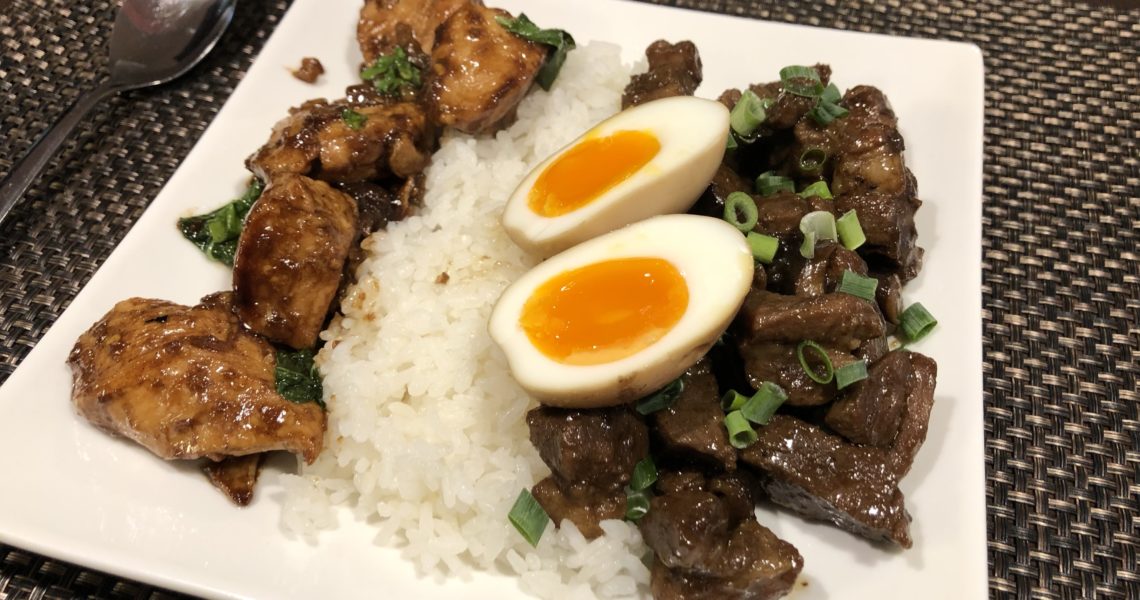
Friday we tried a couple new dishes, Taiwanese rurohan and sanbei chicken. We had some great ruromen (han=rice, men=noodles) in Osaka a while back, so I wanted to try it out at home. The rurohan we made was a version with pork shoulder instead of pork belly to try to save on calories a little. It was very tasty and the kitchen smelled great while making it, but I think I will add even more spices in the future. The sanbei chicken was surprisingly good. We cut up chicken breasts and then cooked them in ginger, garlic, sesame oil, soy sauce, and lots of spices, then wilted in a giant handful of fresh basil leaves at the end and served it with the rice. I’d like to make this dish again – it tasted very Taiwanese.

Saturday was our final big cooking day, and we made three Korean dishes: yangnyeom chicken, japchae, and kimpa. We’ve made these dishes many times, and we’re getting better and better at it. We served these with homemade kimchi and had so many leftovers that we delivered a plate of kimpa to the Fukumi’s house. Even then we still had lots of remaining food for the last day of Golden Week.

Once again it was a delicious holiday. I think we learned a lot of things while we cooked, and that is all part of the fun. Now we get back to work and back to healthier food for a while.

Books: Rhythm of War – Brandon Sanderson

Near the end of last month my library reservation for Rhythm of War by Brandon Sanderson finally came through. At 1,270 pages it was a biggie, and took a while to finish. It is the fourth book in the series, and it seemed to me to be the longest.

All the characters are here – and there is suitable development to keep things interesting and to satisfy the fans. Everybody moves closer to the big showdown that will happen in the fifth and final book.

I’ve read the first three books, and while the first few started out fairly lean and fast-moving, it seems like the more recent books spend a great deal of time explaining how everything works in this world that Sanderson has created.

For me, I prefer the action, twists and turns, and companionship and discovery that is usually a big part of these novels. For some reason this one focuses a little too much on “the rules” for this world. There are chapters and chapters full of science experiments to discover these rules, and it just felt like the information was put in there to cover logical bases rather than to develop the story.

Another point that stuck out for me was that our heroes (especially Kaladin and Shallan) are on the hero’s journey once again. Each book ends with them reaching some sort of accomplishment and solving their personal problems, however the next book starts with them again having some other personal problem or challenge, and off we go again to climb the mountain. The payoff of reaching the summit is always nice, but we know there’s just going to be a taller mountain to climb next time.

It is not all bad news – I especially enjoyed the mystery of the “deadeyes”, and checking in with Lift and Rysn – two side characters that are my favorites of the series.

I recognize that it must be a colossal amount of work to put these novels together, and to make sure everything is logical and makes sense. For casual readers like me, I think this book just got caught up in catering to the hardcore fans, and lost the brisk pace and fun we usually get in Sanderson’s storytelling style. Hopefully all the pieces are in place for the final book and we’ll reach a satisfying finish.

Next, I’m starting on Lands of Lost Borders by Kate Harris.

Even Russian Gyoza

Besides wine tasting our way through Italy now and then, we’ve also been trying to broaden our cooking repertoire by choosing a country for a month and trying to cook its signature dishes. In November we concentrated on Russian food. It turned out to be a hit!

Before I learned better, my image of Russian food was just cabbage, potatoes and vodka. When we went to Russia we ate a variety of foods, and although the dishes we remember mostly were Georgian food (which sent us on a subsequent trip there), this time we focused on what we thought were “traditional” dishes from Russia.

During the month we cooked borscht, piroshki, pelmeni (described to one of my students as Russian gyoza), beef stroganoff, and blini. On the last day Kuniko even did a bonus (Ukrainian) dish of Chicken Kiev. This was the first time to cook most of these dishes, so we learned a lot about what we would do next time. I think we decided that we’d be happy to make any of these again.

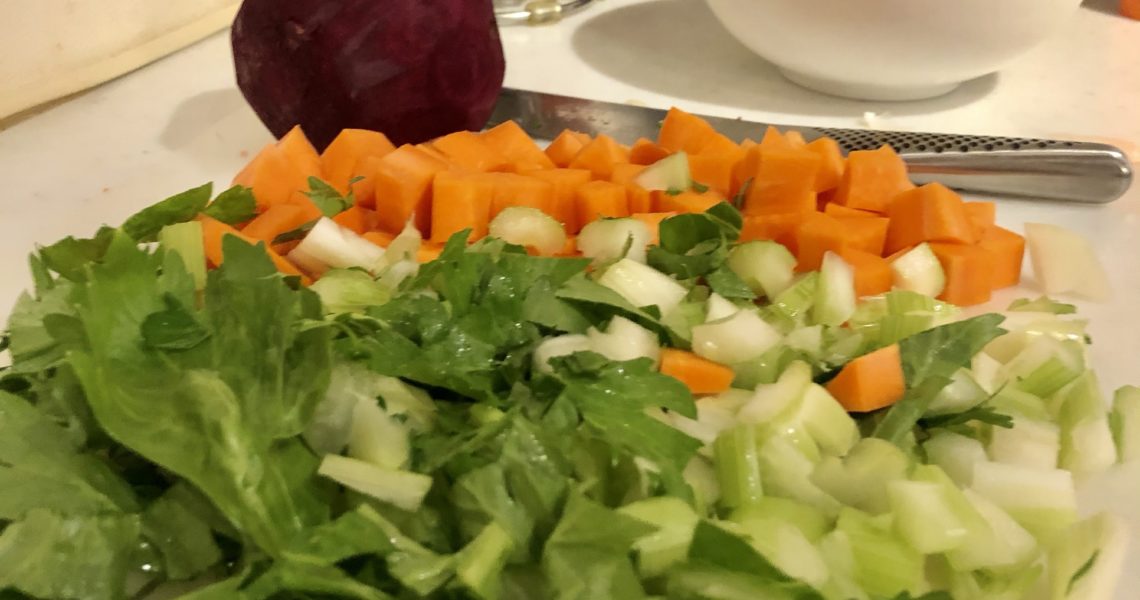
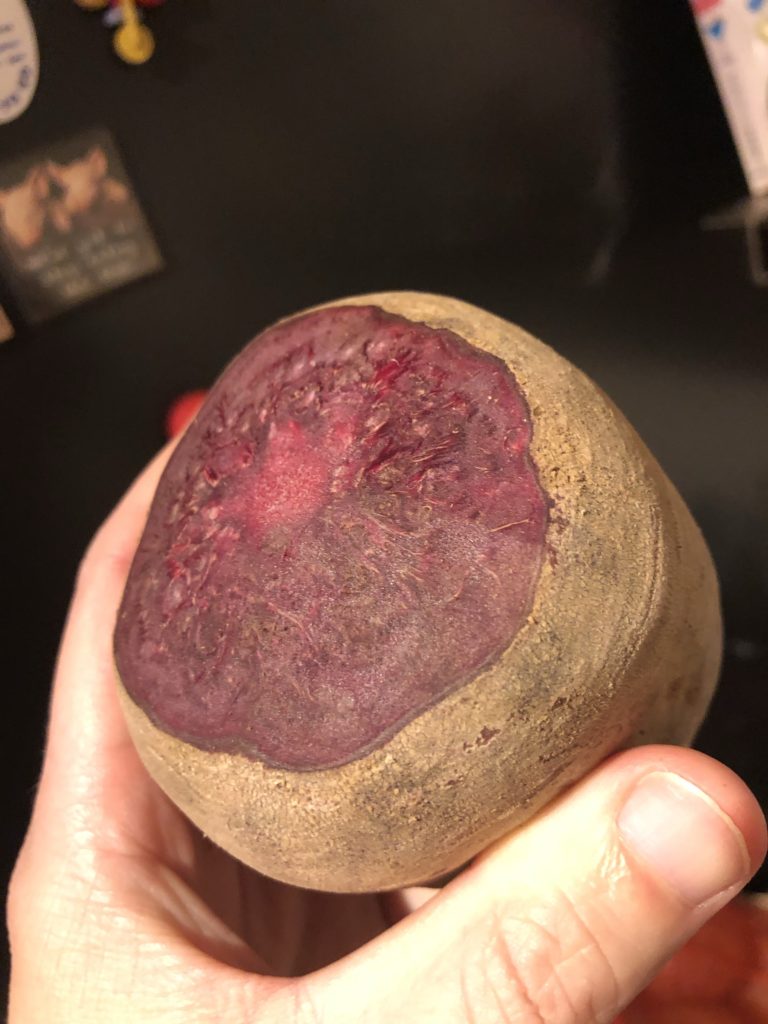
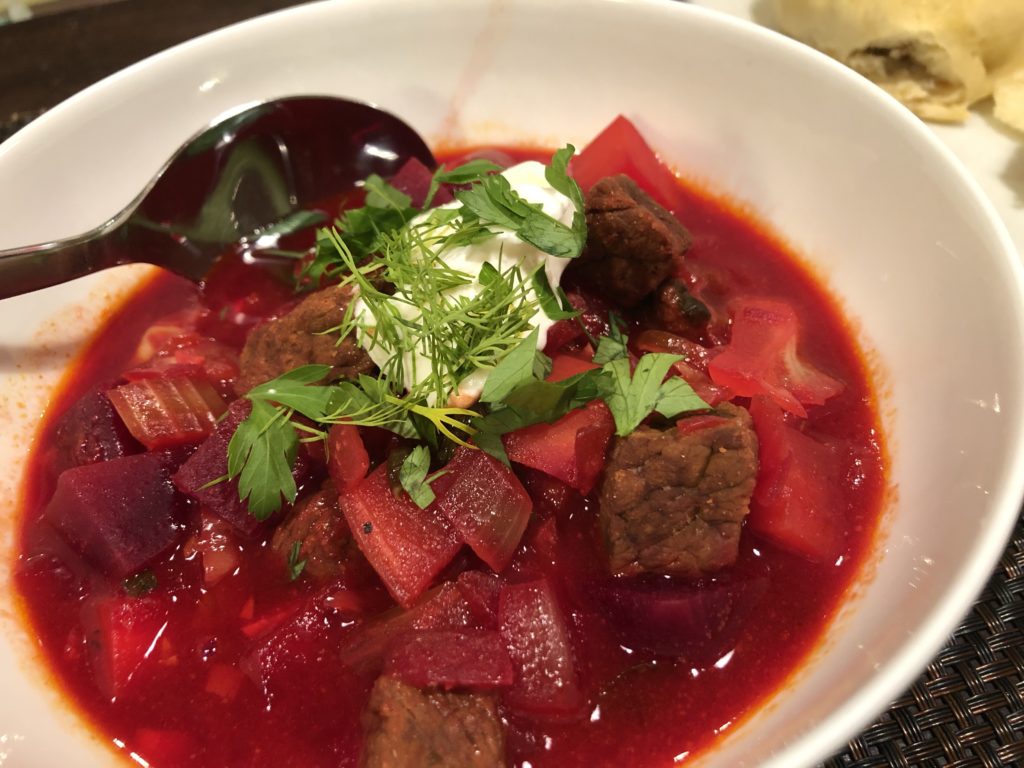
For the borscht, we started with an online recipe that featured chunks of beef and thanks to some very deep purple beets from Nagano it was delicious. Topped with sour cream and fresh dill, the dish really came together. Kuniko upped the amount of cumin which pushed the dish a little to the east of Moscow – yum. We did a second version later on with pork, and I think we liked that one even more. The pork chunks ended up more tender than the beef and so we’ll probably cook it that way from now on.

Big beets from central Japan
Beef Borscht

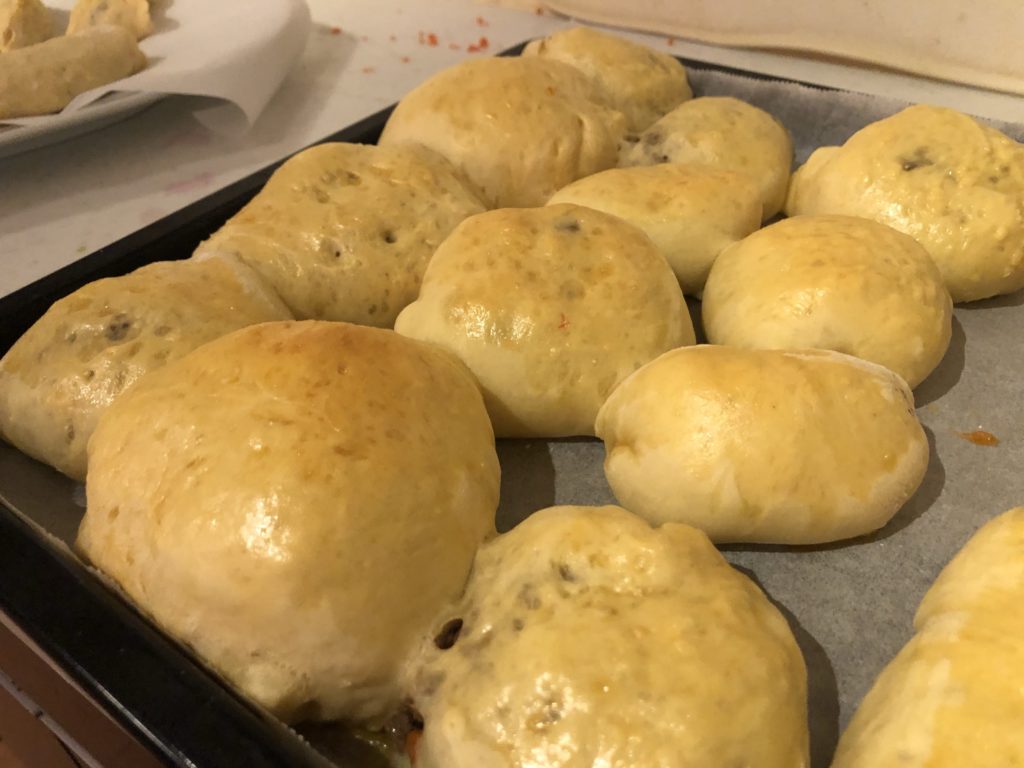
The piroshki also tasted great, although I need to work on shaping them more consistently. In the interest of science I tried all kinds of different folds to see what turned out well and what turned out… alien. We baked ours rather than frying as a healthier option, and there were enough that I was taking them to work for a few days afterwards. The dough was hard work but the result was worth it!

Goofy looking piroshki

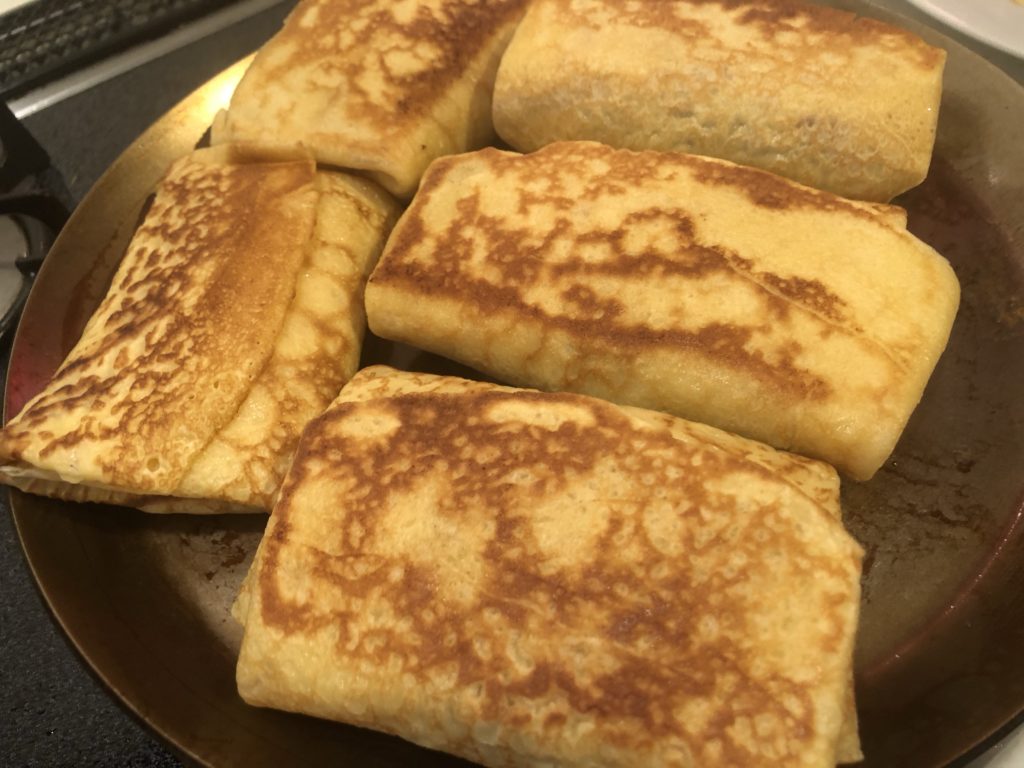
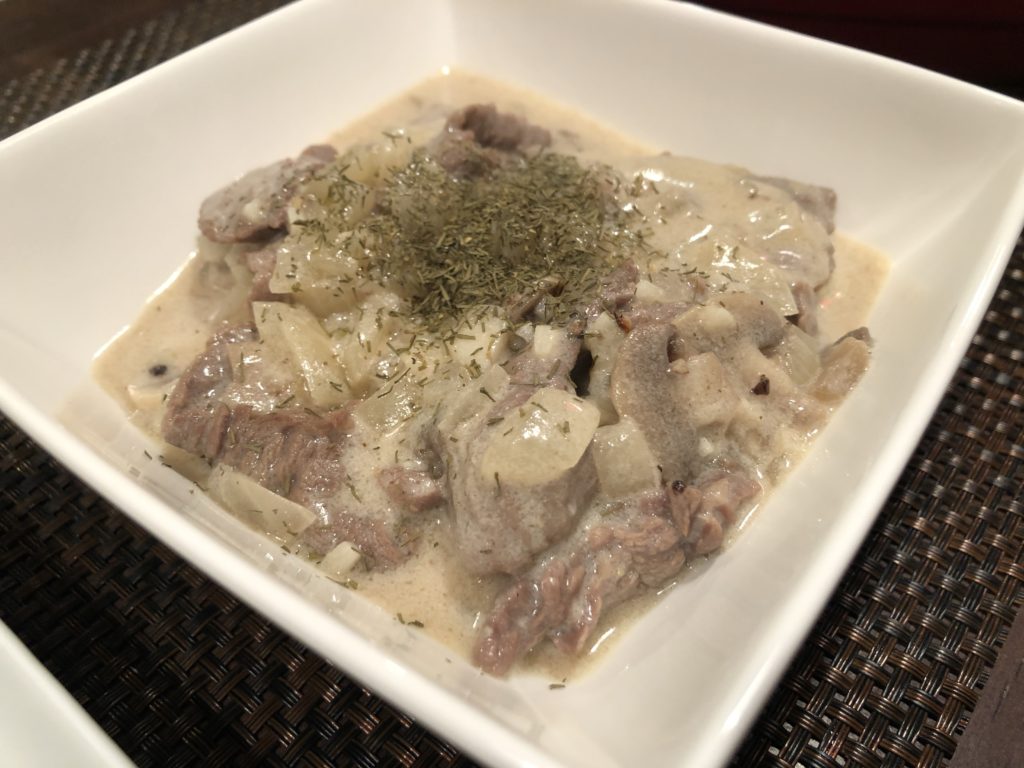
The pelmeni and beef stroganoff dishes came together smoothly. The big hit was the blinis – ground meat and melted cheese wrapped in a buttery crepe and then slightly crisped in butter – holy shit they were good. If I started a food truck this is the dish I’d focus on – wow!

Blini time!
Beef stroganoff sans noodles

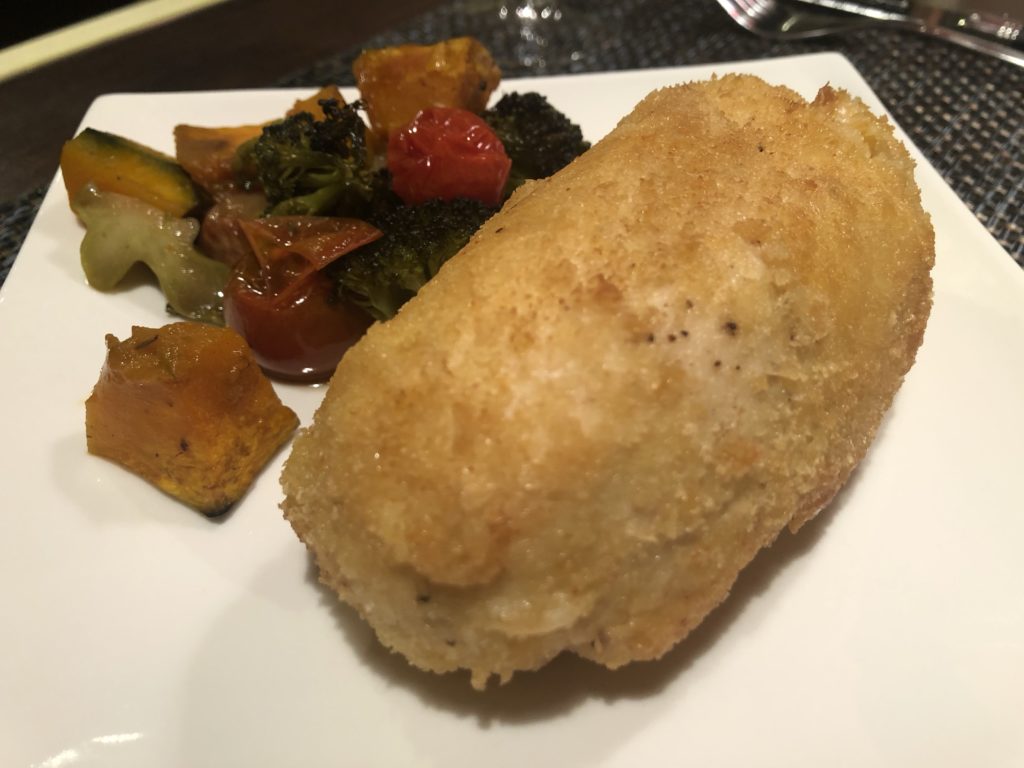
Kuniko really outdid herself on her day off and cooked up some excellent Chicken Kiev. The last time we had it was sitting on Red Square in Moscow the day before our flight back home – this tasted even better!

A burst of butter waiting inside

In December we have a few parties planned so we’re not cooking a country this month. We’ve been craving Korean food so we might revisit those dishes for a while. I am looking forward to January, though. What country should we cook next?

Sipping From the Heel of the Boot

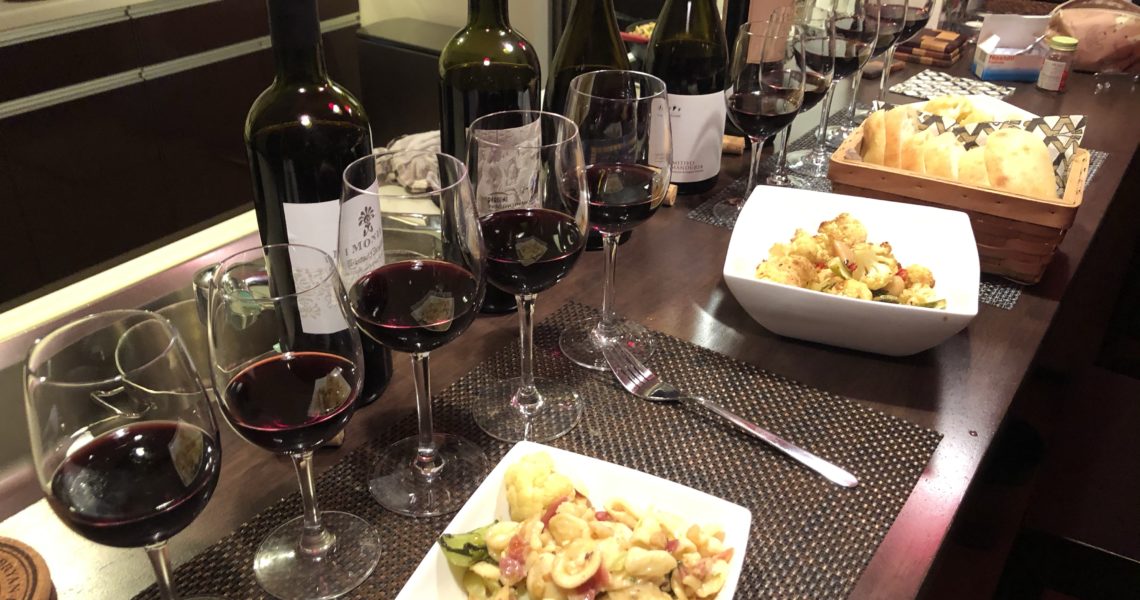
I may have written in the past of our project to taste through the wines of Italy. Believe it or not it has been going on since the start of 2018 – nearly two years ago – and now we are starting to get close to the end. This past weekend we took another step by tasting wines from Puglia, Italy.

You might know Puglia as the home of zinfandel, namely the primitivo grape native to the area. Thanks to the power of DNA matching we can trace zinfandel’s (ahem) roots to Puglia, and it is still going strong there, with Puglia ranked number 3 in Italy for pure wine volume. But volume doesn’t always mean quality, and I chose wines carefully with the help of a big wine book and a few local blogs translated from Italian.

Although there are a few native varieties grown in Puglia we chose to focus mainly on primitivo because of our love for Zinfandel from California, but we also included a negroamaro in both red and rosé form. In total we tasted six wines, and as always it was fun to compare.

The nice thing about Italian primitivo is that they are very affordable – most of our wines were under 20 dollars, and all of them under 30 dollars. They are big juicy wines that have the fruitiness and intensity of Zinfandel without becoming jammy or candy-like which we’ve found with some lower cost California zins.

My personal favorite was a 2017 Primitivo Di Manduria Ferrine, but they were all great wines that were easy to drink. Not a lot of complexity or aging potential, but great to open and serve with whatever you’re cooking.

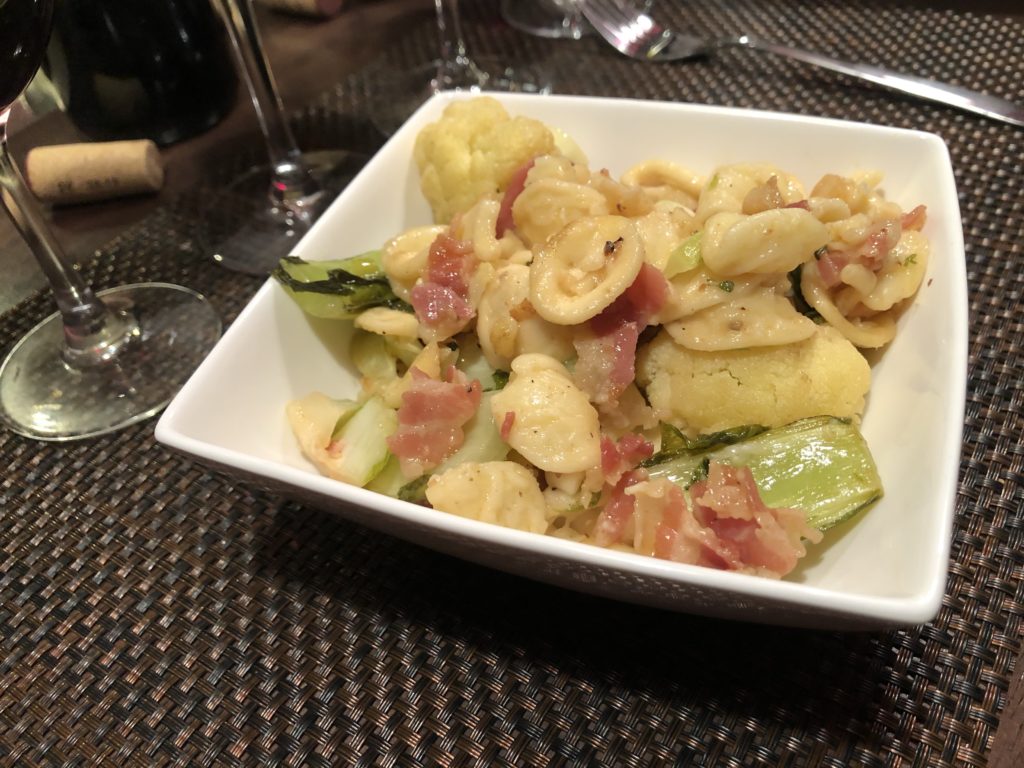
Cauliflower, panchetta and orichette pasta
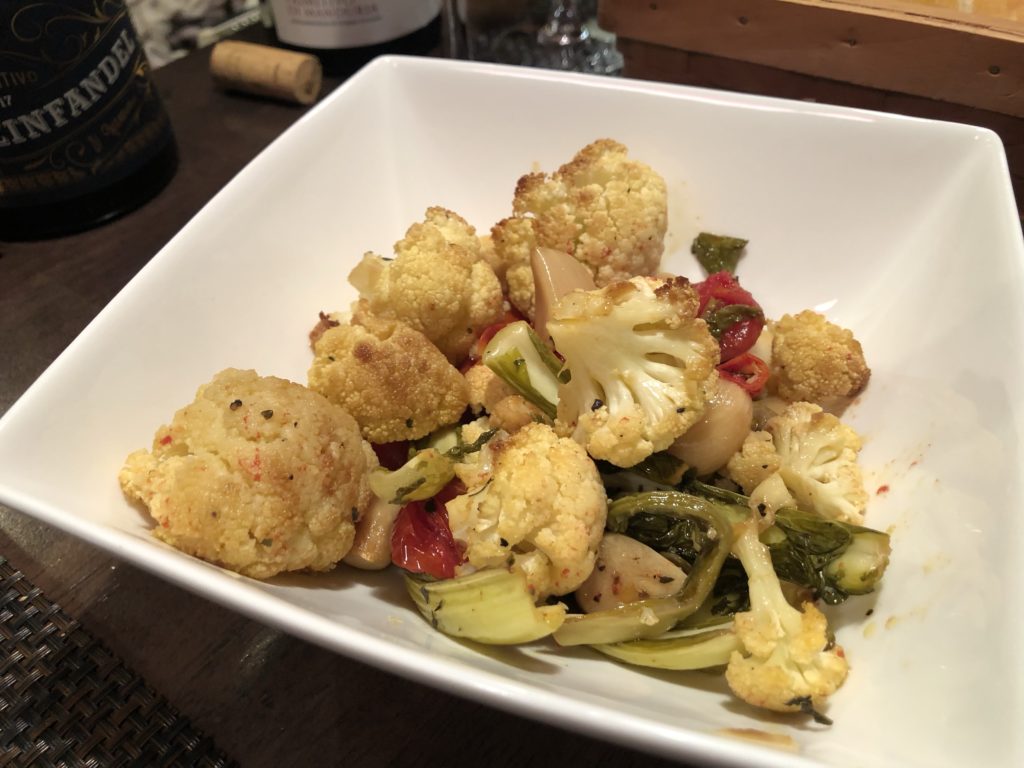
Smoked and roasted veggies

And to go with the wine I followed a pasta recipe recommended for the Puglia region focused on cauliflower and panchetta with plenty of pecorino romano cheese and garlic. Since I had some extra cauliflower I cold smoked it, basted it with olive oil and then slow roasted the florets for a couple of hours together with a head of garlic and some cherry tomatoes to make a side dish. Kuniko brought home some excellent bread from one of her favorite bakeries inside Osaka Umeda station, and the food side of the tasting was covered.

So another checkpoint cleared in our Italian wine tour! Just three regions left – we’ll head to Sicily next, Sardegna after that, and we’ll wrap up the tour in Tuscany, saving the most famous (and most expensive) region for the grand finale.

Holidays at Home

Usually this is the time when I post a bunch of vacation recaps, lots of pictures, and thoughts on our summer travels. Because of the coronavirus things didn’t work out like that, but we did manage to have a very pleasant holiday at home nevertheless.

Kuniko was able to do work for the first week of the holiday, but since I had arranged my class schedule all the way back in January it was a pain to ask all my students to reschedule their classes – so in the end it was easier to just take the time off and relax. I’ve certainly got more than enough vacation days stocked up.

The time off was punctuated with some big events – we had the neighbors over for a Korean dinner, we had Yoshi, Mamiko and Akira over for another Korean dinner, we held two Italian wine tastings (Aglianico from Basilicata, and whites from Campania). In between we were busy in the kitchen. We made savory crepes with pork BBQ, sticky oven-baked spare ribs, gazpacho, Chinese beef stir fry in lettuce bowls, Du Puy lentils, rich tomato sauce with meatballs, and grilled mini-burgers (sliders?). It was good summer eating.

Now we are back at work, and the next holiday on the horizon is a 4-day weekend at the end of September. It is looking like we won’t be able to travel at the end of the year, so we’ll just have to hold out a little bit longer and hope for some relief in 2021… it is tough but we’ll be ready to fly whenever it seems safe!

A Different Kind of Summer Holiday

As I write this at the end of July, I’m in for a new experience. Usually at this point we are finishing our last day of work before our summer trip, but this year we’ll be staying home for the next two weeks due to the ongoing coronavirus situation.

The days before our big trip are always exciting. We are doing last minute research into sightseeing spots, good restaurants to try, and how we might get from point A to point B. We would know the next day we’d be on planes and walking through airports, dealing with immigration and customs and overpriced airport bars and all the enjoyment we get out of all those experiences. Finding and checking in to our hotels, slow breakfasts in cafes and dining al fresco in the cooler evenings. Good cheap wine. Local cheese on every menu.

This year is different, but although missing out on travel means a great deal to myself and Kuniko, it is a small sacrifice compared to what millions of people are dealing with around the world, and especially in the United States.

We are lucky to have stable jobs and be able to get through this pandemic in very good shape. So we’ll miss out on travel this summer, but I’m looking forward to our next opportunity and we’ll enjoy it that much more, whenever it is.

Golden Week Cooking

We just finished up another excellent Golden Week here in Japan, this time under the shadow of the coronavirus. Fortunately for us, the situation was pretty much the same as usual, since we make it a policy not to travel during Golden Week. This time everyone else had to follow the same policy, and other than a few more people in the supermarkets things went smoothly.

Of course we focused on cooking delicious foods during the long holidays, but there was more than just cooking and eating. Of my twelve days off, eleven were sunny and clear, and the temperature was perfect for outside activities. We spent a lot of time on our back porch grilling, sipping cocktails, or just reading books. I weeded and replanted our herb garden out front, this time adding some French tarragon to see how it works out. In a usual Golden Week we’d have a party with the neighbors, but instead we maintained a social distance and just waved at them across the way as we passed.

The real joy of the long holiday is to wake up whenever you like, stroll to the store to buy fresh vegetables and ingredients, and then cooking them up and enjoying a leisurely meal of exactly what you wanted to eat – usually while discussing what you should try to make the next day. You can attempt making things that take a little longer or require more effort, and if it doesn’t work out it is no problem at all – you just have a chance to learn from the experience.

Besides making meals each day I also tried out a recipe for peanut butter cookies spiced with Chinese five spice. As a kid I never had much interest in spiced cookies, but the more adult and Asian taste really hit the spot this time. I don’t think I can go back to regular peanut butter cookies again.

We also exchanged gifts with Yoshi and Mamiko. Since we couldn’t get together we had sent over a nice bottle of sake for them, and they responded with a porch delivery of homemade masks, homemade bacon (!) and homemade bamboo shoot rice. Hopefully we’ll have a chance to get together soon.

So here’s a (long) list of meals we ate during the long holiday, for posterity’s sake:

4/24: Yakitori skewers – This one was the only time we ate food from outside. We wanted to support the local yakitori place that we like so I put in a big order for take out and picked it up on the way home from work. The “shiotsukune” sticks are always the best!

4/25: Caveman steak with green salad and mushrooms – Earlier in the week we had bought this big chunk of beef on the rib bone in a French cut. I salted it up three days in advance and left it to dry out exposed in the fridge before grilling it up. We got two meals out of it and it was a great cut of meat.

4/26: Leftover steaks with roasted veggies – We still had two big strips of steak leftover so Kuniko roasted a bunch of veggies (tomatoes, heads of garlic, broccoli and onions) and everything fit together nicely.

4/27: White jambalaya and cornbread – This was Kuniko’s request. We had some high quality rice in the pantry, so I made up a sofrito, added homemade stock, some fresh shrimp, chicken and sausages, and Kuniko baked the cornbread. The jambalaya came out a slightly saltier than I would have liked so I’ll try to be more careful next time. We still went back for seconds and thirds so it passed the test, I guess!

4/28: Grilled veggie sandwich with cilantro and onion quinoa salad – Kuniko had to go to work this day and she wanted vegetables when she got home for dinner, so I grilled some big shiitakes, pan seared two sweet red peppers and them combined them with tiny sprouts, melted Okinawan cheese and brown mustard on bread from the local bakery. They turned out great!

4/29: Whole roasted Akashi snapper – We did a wine tasting of five different wines from the Italian region of Le Marche, and since the coastline there has a lot of whitefish, we roasted this one up. We found a whole snapper at the local supermarket already cleaned out, so I stuffed it full of fennel, garlic, Italian parsley, olive oil and salt, then we roasted it whole until the skin got crispy. I want to do this more often – so good!

4/30: Cajun shrimp skewers, grilled corn, mushrooms and paprika peppers – Still on a Cajun kick, so we bought some extra big shrimp and grilled them outside slowly while drinking cold beers on the back porch. The great weather this holiday contributed to a lot of grilling decisions.

5/1: Grilled cumin-marinated pork shoulder and green salad – More time out back grilling. This was a last minute decision but the roasted cumin made a pretty good quick marinade. The cut of pork from Costco was a little fatty, but finally the flavors came together at the end. I’d marinate it longer if I had to do it again.

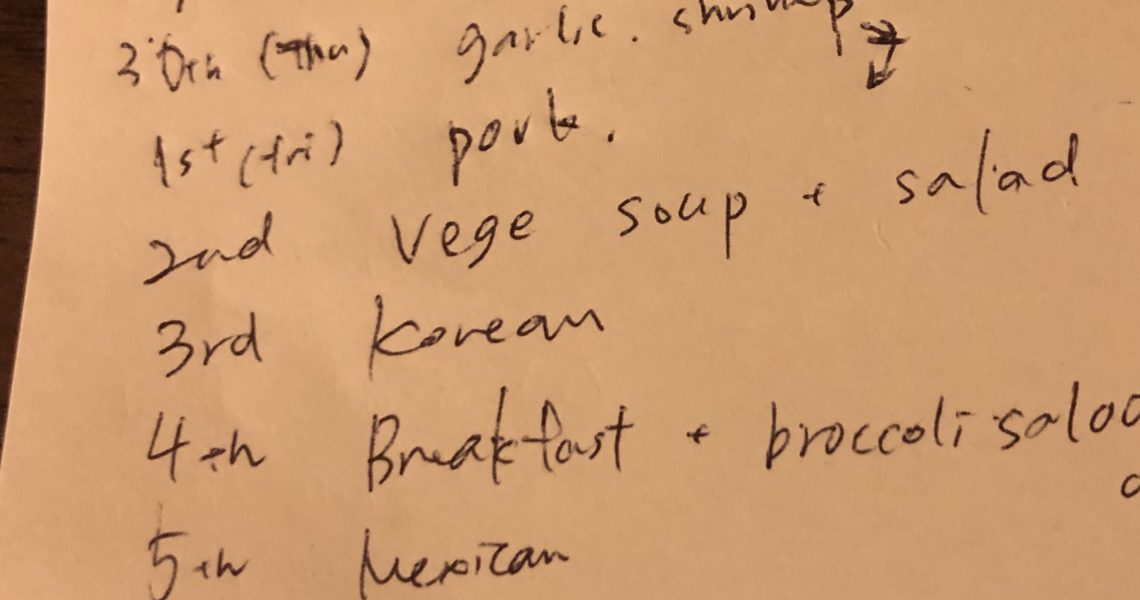
5/2: Mixed vegetable soup and steamed veggie salad – This was the answer to the heavy dishes we’d been eating. Kuniko made everything here, as kind of a detox meal and more like what we regularly eat during the work week. All the veggies were fresh from the market so the final soup tasted naturally sweet. It was a refreshing break, and I think our bodies appreciated it!

5/3: Korean kimpa, gangjeong chicken, homemade kimchi served with makkori – Although April was Korean cooking month for us, in early May we still had some ingredients and motivation to take another swing at these dishes. Kuniko has really masted the kimpa, and her version of gangjeong chicken is getting better and better. We also killed off the last batch of kimchi so we’ll need to make another!

5/4: Homemade bacon, waffles and eggs with tangelo mimosas – Yoshi and Mamiko had dropped off some homemade bacon on our doorstep the day before, and Yuki had given us a waffle maker for Christmas, so we decided to have a big breakfast for a change. Kuniko made up the waffles, I fried up the bacon and eggs and we enjoyed everything with mimosas made from the juice of the American tangelo oranges we’ve been able to get recently. Dinner was very light – just a broccoli salad – we were operating on the “one big meal a day” policy.

5/5: Grilled chicken tacos with Patron margaritas – We celebrate cinco de mayo every year with Mexican food, and the tacos (burritos?) that we made this time were excellent. I haven’t found better Mexican food in Japan than what we make in our own kitchen (but from the state of Mexican food in Japan this isn’t saying very much).

5/6: Cubano sandwiches (a la Chef) – The last day of the long holiday and so we made these sandwiches. The pork shoulder is brined for 24 hours, marinated afterwards for several hours, and then roasted for nearly three. We went to Akashi to buy raclette cheese, and Kuniko baked fresh bread to stand in for “pan cubano”. It is a lot of work but these were delicious and made for a nice capstone to the long holiday.

So that wraps up another great Golden Week menu. For the month of May we are planning to try to cook some different dishes from Spain. We’ve got a big Costco-sized bottle of olive oil ready to go. I know we’ll have more delicious meals coming up – hopefully they’ll be a bit more spread out!

Situation: (Almost) Normal

Someday when I look back on the entries of this blog I may wonder to myself what was happening with us during the start of the coronavirus in Japan, and so I thought I should write up a little about what’s been going on with our lives in these unusual times.

Even though there are some dramatic lifestyle changes all over the world, and some countries (including the USA) with a startling death toll, life for us has not significantly changed. I think the reason for this is likely a unique combination of circumstances for our work and lifestyle that were in place long before the coronavirus showed up.

As for work, I teach mainly one-on-one classes in a private classroom so I can avoid large crowds at work. I come face to face with my students and that’s it – between 4-8 people in one day. Similarly, Kuniko’s school is a correspondence school, and she rarely has to meet her students face to face, instead dealing with them over the internet. With the coronavirus they have added the option of doing remote work, so she has even less exposure by not commuting several times a week.

And Japan was already a country that sort of practices social distancing. Handshakes and hugs are rare, 70% of people outside wore masks already, and my guess is that number has moved up to around 90%. Things are clean, shoes (and whatever is on the bottom of them) are left at the doorstep, and people already wash their hands and gargle as a preventative step to colds and influenza – something that is taught to every Japanese student from elementary school age.

Certainly there have been changes. All public schools and most private ones are closed for now. Many retail shops are closed, although more are opening back up recently. Restaurants and bars are struggling and hoping that take-out orders and emergency government subsidies will be enough to sustain them until voluntary restrictions are lifted.

Big companies like mine are still open, and the use of remote work has increased tremendously, giving workers more flexibility but also giving them much more independence which may feel very foreign to some.

The real struggles going on are the ones that are not visible to most people. Companies in Japan both large and small have shifted over the past few decades away from the lifetime employment model towards a dispatch worker system. Many companies pay another kind of company, called a dispatch company or staffing company, to provide workers to do regular work. This gives the original company more flexibility in changing the workers, cutting them when business is slow, and reducing fixed costs in the long term. This trend was already bad news for the dispatched workers as job security was much lower, and until recently they would get paid less for doing the same work as lifetime contract employees.

So with many retail shops and restaurants closed these workers have less income, and they wait at home for a call from the dispatch company sending them somewhere if they are lucky. Some may have kids to take care of (since schools are closed) and so they struggle. I imagine many families are in this situation now, and it must be tough for them.

The sudden appearance of the coronavirus has been a particular challenge to the government of Japan. Leaders in Japan tend to take plenty of time to discuss things carefully, gather relevant data and analyze it, and then take cautious incremental steps towards overcoming a problem. This sort of approach seemed to be exactly the wrong tactic for something as fast-moving and evolving as Covid-19. Even under this pressure the pace of change is still slow, and I hope that lessons will be learned on the value of flexibility and speed. It isn’t fair to single out only the Japanese government here – many governments are struggling all over the world – but from my perspective the prime minister of Japan and his government’s resistance to making a concrete decision caused more confusion and problems than it should have.

But amidst all of this bad news, Kuniko and I found ourselves in a good place. At the start of February my company assigned someone to help me get a permanent residence visa. Until now when I had to renew my visa (every 3-5 years) it was all on me to go through the bureaucratic nightmare – taking time off to go get the forms from various government agencies, and then taking more time off to apply in person and more time off to pick up the visa once it was completed. This time I had someone to help me get the necessary documents, pay for all the forms, stamps, and application fees, and let me leave the office to take care of things myself when I needed to. At the end of February I received my permanent residency visa (with no expiration date!) and I have my company to thank for going to bat for me on this. I never asked them to help me but sometimes it is good to have a big bureaucratic machine working in your interests.

We’ve both got solid jobs, steady income, and with no kids and plenty of food and things to do at home it has been extremely easy for us. We are some of the lucky ones, at least for now, and so the best thing we can do is avoid taking our situation for granted, to do what we can to help others who need it, and to stay healthy. Of course there is still the possibility that people’s lives will continue to change, and we’ll try to be flexible enough to be ready for it when it does.

Eating Well

We were lucky enough to have a three day weekend, thanks to the new Emperor’s birthday. I’m not sure what he did on his birthday, but we ate a lot of great food.

Starting with Friday night, we went out to eat to celebrate Kuniko’s birthday at Tajima-ya, a yakiniku place that we hadn’t visited in a long time. It is a very busy place and it is always tough the get reservations. They give you a short time limit too, so we had to eat the meat and hit the street.

There are a lot of yakiniku places in Japan that focus on quantity, but at Tajima-ya they serve some great cuts of beef. The Korean noodles and kimchi also help to set the mood, and we really enjoyed cooking up the beautifully marbled Japanese beef grilled over white coals.

On Saturday I put together a wine tasting of Umbrian wines, two whites (Orvieto Classico and a Grechetto), a monster red (Sagratino di Montefalco), an odd duck – a passito red also from Montefalco. Truffles are a big deal in Umbria, so I kneaded out and made my own noodles and then cooked them in a black truffle sauce. Kuniko’s contribution was a broccoli, bacon and mushroom salad, and that was how we got a little taste of Italy on Saturday.

We got an early start on Sunday by walking along the beach towards Akashi. This route we’ve been walking for years, and if the weather is nice it is very refreshing to take in the ocean views while walking briskly for a couple of hours. The last time we did the walk we were surprised to find that one of the old warehouses had been converted into a very modern beach-facing burger restaurant, and so we decided that today was the day to try it out.

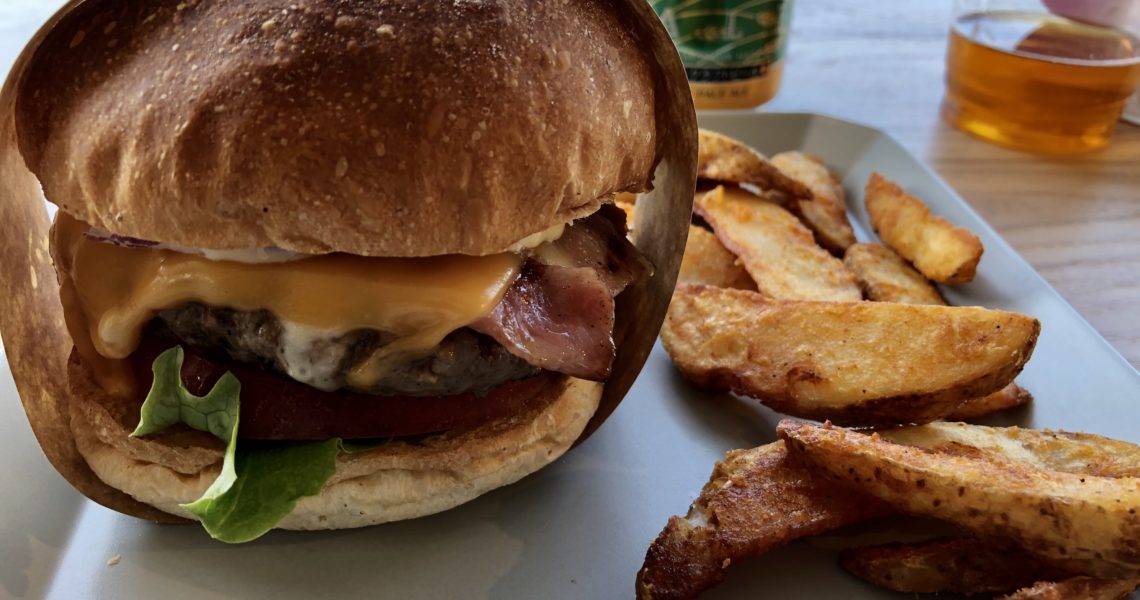
The place is called “The Fantastic Burger” and while I’m not sure I’d call them fantastic, they certainly were delicious. We sat facing big glass windows looking out over the inland sea, and sipped on Yona Yona Ale while we waited. Burgers and beer at 10 am? It must be a holiday weekend! They had several kinds of burgers, and the ones we chose were well-made. The owner/cook was a young guy and he said that the location was a bit risky – while it is easy to get attention from people walking it is much more difficult to find by car. But it seems business is doing OK, and I hope that we can drop by again sometime soon. It does threaten to cancel out the calories that we should be burning by walking on the weekends… temptation at the halfway point.

Once we reached Akashi we walked down the fish market street and picked out some big hunks of freshly caught snapper, and that turned out to be our dinner. We are continuing to work on building seafood skillets similar to what we enjoyed in Reykjavik Iceland, and this time was one step closer. I worked on the sauce in two stages, which seemed to make for a more cohesive taste later on. Delicious with the leftover Italian white wines, too!

Then on Monday, we drove out to our new favorite local vegetable shop and stocked up on things for the week. Kuniko spent the day in the kitchen, making up ginger chicken soup, baking two kinds of bread for sandwiches, making cornbread, and also baking banana bread. Since the weather was beautiful I grilled up some big cuts of pork with plenty of BBQ sauce, and also some skewered fat erengi mushrooms. Kuniko threw together an Asian salad with cilantro, lettuce, avocado, tomato and sweet chili sauce, and it felt like summer again.

These holiday weekends are great chances to eat plenty of good food. Happy Birthday Mr. Emperor!

Cursed With A Third Name

Fun fact – Japanese people don’t have middle names. This ends up having a surprisingly large effect on people that do.

Recently I’ve been working on getting what is called “permanent residency” in Japan. Until this year I have been living in Japan on a spouse visa, which is quite nice and has no restrictions on my economic behavior. The only downside is that I need to re-apply every five years, and my staying in Japan depends entirely on the continuing existence of my Japanese wife. The permanent residency visa is for ten years, and also carries no restrictions on what I do or how I make a living.

I was perfectly willing to continue getting my spouse visa every five years, but my company recently volunteered (without prompting) to support my application for permanent residency. They assigned someone to help me dig up all the papers, they let me leave work (on the clock!) to go to the various government offices and get official documents, and they even said they’ll pay all the fees on top of it. It was unexpectedly kind of them – and has done more to earn my loyalty than the quarterly bonuses that they dutifully pay out.

The official government documents have been a real challenge, too. It is quite simple for Japanese people, as they have just a family name and a given name, and it is effortless to match up their official identification and government records. But thanks to avarious factors it can be tough for me.

There are lots of ways to write my name in Japan. Here’s a few:

Bryan Fredricks, Bryan David Fredricks, Fredricks Bryan, Fredricks Bryan David, BRYAN FREDRICKS, FREDRICKS BRYAN, FREDRICKS BRYAN DAVID, ブライアン フレドリックス, フレドリックス ブライアン, フレドリックス ブライアン ディビッド

So I just listed about ten different possible combinations of my name, using various letter sets,word orders and languages. If I apply for a document with the wrong set then it means rejection, delays, and more time off needed to go back to the government office for another attempt.

One office had online access to the documents I needed – Great! However their website didn’t have a field for middle names, and so I would try one of the combinations above and receive a message saying that I would receive a postcard (in the mail) after five working days with the login/password for the site. After waiting anxiously for five days I receive a message in Japanese saying, “Your name doesn’t match our records. Please try again.” It is a bit like playing the lottery.

Another hiccup occurred back when I first joined my company. They told me that they couldn’t pay me (which got my attention rather quickly as you could imagine) because my bank account name didn’t match my passport name (see all the combinations listed above) and so in the end it turned out to be easier to go open a new bank account with the version of my name that matched my passport. I am happy to report that I could receive my salary in a timely fashion thereafter.

Actually I am simplifying a lot of things and these processes are quite a bit more complex than the way I am describing them here. But I am short-cutting in order to briefly illustrate the fact that having three names is burden here in Japan. I can’t imagine what it must be like for people with four or more names! But hopefully, in the next six months or so I’ll be classed as a “permanent resident”. I guess that means that I’ll be permanently stuck dealing with this maddening system.

New Year’s Eve in Kuala Lumpur

Another morning, another run to the Lot10 food court. Most food courts have just 10-20 shops, but this one had 40-50 different places, all close together for easy access. One shop we noticed yesterday had a huge line of Chinese people waiting, so this morning I went there first and got a good position at the front of the line. The dish was worth it, too – Duck Egg Fried Kuey Tow – flat noodles mixed with duck egg and vegetables and cooked up in a big iron wok with plenty of hot sauce. Kuniko picked up some beef noodles, which were also awesome. And we also got a few more custard buns. 

We did a little more poking around the area of the park and Kuala Lumpur Convention Center, checked out the twin towers gift shop to see if they had any stupendous ornaments for our tree, and then ended up at a shopping center restaurant called Madame Kwan’s for a traditional Malaysian lunch.  This time we had fruit rojack topped with soft shell crab, a fairly good beef rending, and a steamed fish cake wrapped in a banana leaf called otak otak. We weren’t a big fan of the fruit rojack, but the crab on the top was great! We also really enjoyed the fish cake – I think it would see well in Japan. For dessert we ordered a shaved ice sort of dish with beans, tea jelly and a big dollop of durian on top. I liked everything but the durian – but Kuniko had no trouble and ate it all. 

With our shopping pretty much out of the way, we retreated to our hotel room to relax. The fridge was stocked with a couple bottles of sparkling wine, we had snacks, and so it was just time to wait for midnight. We spent most of the time napping, using the big bathtub, and snacking, until finally it got close to twelve o’clock. The park underneath the tower had some sort of concert going on, and even from where we were we could hear the music. More people gathered under the Petronas Towers and when midnight hit they let loose with some serious fireworks. The fireworks mainly exploded at about our height, between our hotel and the towers beyond the park. It made for some dramatic viewing, and it was a big payoff to the end of 2019. 

We slept in the next day and then headed off to the airport, catching a flight out of Kuala Lumpur in the early afternoon and arriving around 9:30 pm in Japan. We barely caught the bus from the airport to Kobe, and ended up arriving at home a little after 11 pm. The colder weather was a shock – back to electric blankets and long underwear. It was another great trip – we were never bored and ate so much good food. I don’t think we’ll forget this winter holiday for a long time. 

Welcome to Traders Hotel

The next morning we followed through on our promise and went straight away to the Lot10 food court, and enjoyed wandering the relatively uncrowded area looking at all the food options on display. We decided on a steamed Chinese rice crepe, rice and braised pork wrapped in a banana leaf, and some more salted egg custard buns because we just couldn’t get enough. 

We checked out of our hotel, and caught a Grab to our last hotel of the trip, the Traders Hotel. Kuniko had booked this hotel back in Christmas 2018 while we were staying with Mark and Susan in Tampa, and she did a great job. The room was large, luxurious, and from the 14th floor had a dramatic facing view of the Petronas Towers and KLCC Park below them. This was our first time to get a look at the landmark towers since being in Malaysia, and they are pretty dramatic. 

For fun we went up to the top floor (floor 33) to check out the swimming pool and sky bar. The pool was an indoor pool and quite small – but unfortunately it was not available for guests due to some sort of technical problem. We settled for cocktails from the sky bar and sat next to the pool enjoying a slightly higher view of downtown KL. The pool area and bar were remarkably empty – it was just us, the pool maintenance staff, and a group of women posing for their Instagram next to the windows. There were advertisements for a countdown party the next day, with “platinum” tables available for big money (5 bottles of champagne and 5 bottles of whisky included!) and interesting celebrities and DJs. We’ll stick to our own room, thanks. 

Later in the afternoon we went out by train to Kampun Baru, a kind of local’s street food area. We walked through what seemed like a regular neighborhood street, but the front yard of each house had been converted into open air food stands and restaurants. Things were kind of quiet when we walked through, so we kept going, finding lots of backstreets and several fruit markets and even a big butcher’s market area where they were busy cutting up chickens and fish. Eventually we found our way to Kuniko’s target restaurant, called Limapulo. It was a stylish place with both indoor and outdoor seating, and it was easy to take a table outside under an arbor and order up some good food. We started with juices – I had lychee and Kuniko had carrot – and then an appetizer which was like a flat egg omelet, called telur cincaluk. We followed it up with a bowl of nyona-style Malaysian noodles, this time with a thick soup broth that reminded me of Japanese miso ramen. We also had a plate full of tiny thin noodles – with egg, cabbage and spices. These noodles had a coconut spice flavor that I couldn’t get enough of. 

On our way back we passed through a big Aeon market – a Japanese company that is looking to make inroads into Southeast Asia. The mall was pretty empty though, and I don’t think it has a good long term outlook. Back in Kampun Baru Kuniko bought a mango susu – blended frozen mango, with a little juice and then big chunks of fresh mango on top – it was outstanding. 

Finally, we returned to the area of our hotel and did some shopping at a nearby market (called “Cold Storage”) that was really busy. Tomorrow is New Year’s Eve, and it seemed like people were getting ready to party. 

Back in Kuala Lumpur

Using Uber we ordered a (very) early pickup at our hotel to take us to the airport for our flight back to Kuala Lumpur. The drive was smooth and as we passed the bus terminal we saw that the stands and markets around it were absolutely hopping with people at 4 am in the morning. Apparently it is a good idea to stock up on supplies before riding a long distance bus out of town. The airport had three security checks before we even arrived (we handed our passports through the window to the armed soldiers) and then we had to go through the rest of normal security inside the airport. The airport itself was pretty quiet, although not well-organized – one security guy told me to go, at the same time another one told me to stop. Surrounded by salespeople sleeping in their shops, we had a breakfast of quiche Lorraine and some coffee to wake up. After a long wait for the final security check we finished boarding, and enjoyed another great meal on Sri Lankan airlines. 

It seemed like a very short three hours and we arrived back at the same Kuala Lumpur terminal that we had left a couple of days ago. We still had great memories of those salted egg custard buns from Din Tai Fung and so we made a special trip back up to the departures area to have some more. 

We chose a bowl of spicy noodles with wonton from the menu, and then two orders (8 buns!) of salted egg custard buns. The way the ordering system works in the restaurant is that you check off what you want from a paper list, and then the staff comes and gets the list and later returns with your food. We were really excited to eat more custard buns – really, really excited. The noodles arrived first and they were really good – served as dry noodles but with plenty of spice and heat to make it interesting. The staff arrived and stacked up two baskets full of buns, and when we took the cover off the basket a cloud of steam escaped, and there they were – eight little buns of joy. I happily took the first one and bit into it and- what the hell? I got a mouthful of yam paste. 

Oh, no! It turns out we marked the wrong spot on the sheet, and now we had eight buns of sweet yam paste instead of what we really wanted to eat. Yam paste is not bad – but it isn’t something that will shake your soul like salted egg custard. So after the tears of laughter/shock/grief ended, we got to work eating eight yam paste buns. And then we ordered (correctly, this time) 8 salted egg custard buns and ate those too. Sometimes it takes a little extra work to get what you want, and we paid the price. What was supposed to be a snack became a big meal, and I think the staff understood what happened and were giggling to themselves as we dug deep to finish those yam paste buns. 

After the meal we were able to catch a Grab to our hotel for that night. Grab is a useful application in Malaysia for ride hailing, and it seemed hugely popular. It was cheaper than taking the train, although you are paying a less obvious cost in CO2 impact and pollution. The prices were unbelievably cheap (unsustainably cheap, I thought), so it makes a good system for a tourist to get around. When Kuniko set up the application on our first day in Malaysia, she had to look into the camera of her smartphone and slowly nod her head so they could take a clear picture for the driver to identify her for pickup. So it was an odd situation to be standing in the hotel lobby nodding sagely at your smartphone in the hopes of catching a ride. 

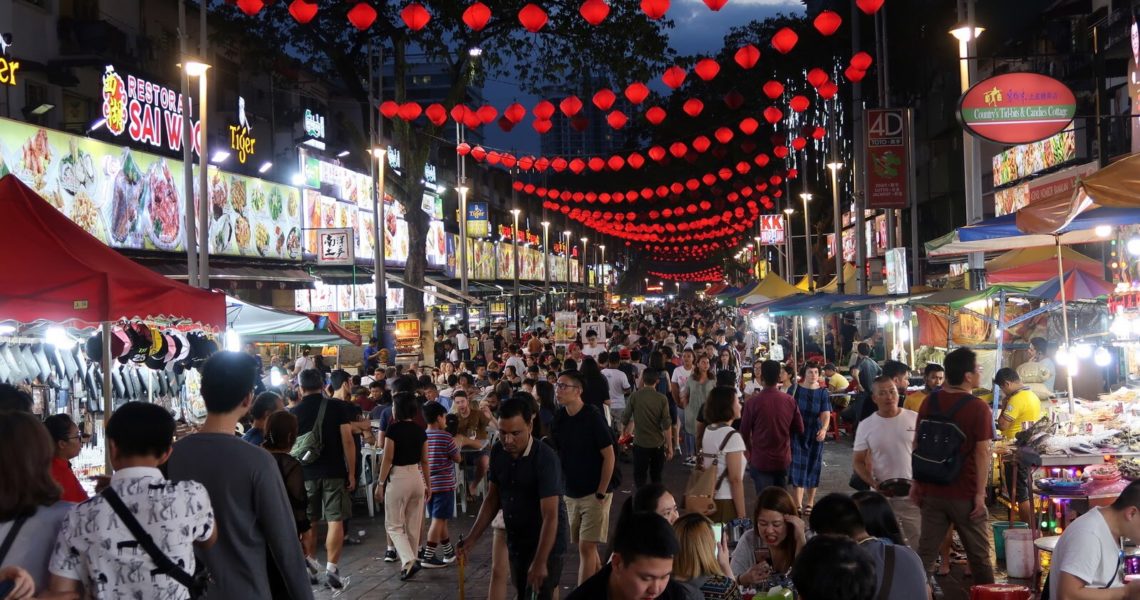
We stayed at a different hotel on our return – just for one night – with a comfortable (king-size?) bed and a great location right next to the street food market area of Bukit Bintang. In the early evening we walked over to the Jalan Alor area, a place that we had visited before in the morning. Last time we visited things were closed up but in the evening it was a completely different feeling. All the food stands were opened up, with plenty of tables available for diners to sit on the street and enjoy the atmosphere. We started with 10 satay skewers – a mixture of lamb, chicken and beef skewers with the critical peanut sauce on the side. Beer here was very expensive – almost the same price as in Japan, but I guess that is to be expected in a street food market in a Muslim country. We were lucky to get alcohol at all. 

The satay stimulated our appetite so we went down the street trying other things – gyoza, dried glazed salami, roast pork, and at one restaurant we had two big plates of vegetable stir fries to get a little green into us. Our seat at the last restaurant was out on the edge of the street, so it was perfect for people-watching. There were a lot of foreigners like us, a grievously burned man begging for change, an armless man was singing songs from a microphone he had set up on the street, and a tiny lady in a wheelchair had a karaoke speaker mounted and she crooned as she slowly rolled down the busy lane. Next to us a group of three teenagers grabbed a table and proceeded to bask in the attention they were getting by smoking and drinking mysterious beverages in clear plastic cups. The staff of our restaurant clearly didn’t like them being there, but the teenagers didn’t mind – they stayed glued to their smartphones trying to look cool. 

On our way back from the bustling market we stopped in at the basement of the Lot10 shopping mall. The food court was huge – all focused on Malaysian and other Asian dishes. We decided right then that we’d definitely come back once we had space in our stomachs. Kuniko bought some melting peanut candy from a Chinese shop on the way out, and with that we called it a day and headed back to our hotel. 

Colombo, Sri Lanka Day Two

The next morning we got out of bed a little later than usual, still sleepy from the nightclub noise above us. We got ready and went out to catch an elevator to the ground floor. We pushed the elevator call button and the door opened right away, and there was a guy just standing in there alone. It caught everyone by surprise, and the guy just nodded at us and said he didn’t mind going down. He got off in the lobby with us and started talking to the staff so we weren’t sure if he worked there or not – but it was a weird situation. 

Our plan for the morning was to take advantage of the lack of direct sunlight and try to walk out to see the Red Mosque. It wasn’t far from our hotel, and with the sun still not quite rising it was a very comfortable walk for us. We passed a dingier side of the city, with dogs sleeping alone on the streets, some shops opened but most closed and locked down. After a wrong turn we passed by a fish market that looked industrial, run-down, and not the least bit sanitary. At last we reached the area of the mosque, and found it surrounded on all sides by buildings making it very difficult to take a picture of the very striking colors and architecture. The streets were almost empty, so it was easy to walk around, and we noticed that the opening time of the mosque for visitors was 9:30 am, so we had some time to kill before being allowed in. 

For breakfast we went to a nearby restaurant that we had researched the day before, open at 6:00 am and serving locals lots of traditional Sri Lankan foods. When we arrived they were slapping around the roti in the front of the shop, which was a very good sign for us. The back of the restaurant was a seat yourself system, and nobody spoke English. Luckily there was a big menu on the wall with pictures and the names of the dishes written in English, so we managed to order some food in this way. Our waiter had no idea what we were talking about but he did know one English word, “egg”. Thankfully some customers helped us out by translating, and we ended up with a breakfast of egg hoppers, and plate of egg kottu, and a bottle of Coke for me with a straw that was too short, making me really do some creative moves with my tongue to get any product out of the bottle. The food here was excellent, so good that we wanted to take some to go. This turned out to be a real fiasco, though, as we tried to order things based on the name and the picture, having no idea of the scale of the photo. We ask for two of something and he says no – you have to order ten. We order two of something and he says that is way too much for two people. Total confusion, but we finally left with a big bag of food and took it back to the hotel to eat. There we discovered two huge loaves of pittu (coconut rolls) which was one and a half too much for us. Also we got 10 string hoppers which was the perfect amount, and two small bowls of curry with an egg in each one. All that food, including what we ate back at the restaurant, for the price of about $3 USD. 

After a little break in the hotel room we went back out, hoping to catch a tuk-tuk to see a couple of nearby Hindu temples that are popular sightseeing spots in the area. There was a tuk-tuk waiting right outside our hotel, but he tried hard to get us to book a city tour with him for the whole day. When we asked how much to go just to the temple, he quoted a price that was triple what longer rides had cost the day before. We smiled and said no thanks, then left to find a tuk-tuk farther away from the hotel. The next price was half of what the other guy had said, so it pays to shop around. Actually, I don’t mind paying the higher price – it was still cheap – but the principle of ripping people off because you can just rubbed me the wrong way. 

We arrived at the temple in just a few minutes. The Gangaramaya Temple is an odd collection of buildings housing a wide variety of religious artifacts, Buddha statues, and texts. It is sort of a collection of things more than one organized temple but it was definitely worth the visit. On the grounds we found a mystical tree looking like something out of a comic book, a collection of old cars donated by wealthy patrons (including a Rolls Royce), a hand operated elevator, and a mysterious spaceship-like shrine flanked by Buddha statues. It was fun to poke around. 

Just a short walk away was Beira Lake and on the water connected by a bridge you could visit the Seema Malaka Temple and enjoy views of the modern city architecture and the ancient religious statues. We also made the walk over to “Gallery Island” which was less impressive and seemed to be a refuge for couples looking to enjoy a little privacy while courting. As we walked around the lake we saw two guys sitting and talking, with a tiny monkey sitting next to them – I guess monkeys are no big deal around here but it certainly would have made me uncomfortable. 

Our next plan was to take a tuk-tuk back to the Red Mosque – it had been closed in the morning when we walked there and we were hoping to get a look inside. After flagging down another tuk-tuk we had to repeatedly refuse his offers for a city tour, or to go to a jewelry shop. Our driver asked about Kuniko’s country, and then said, “Ah, Japanese ladies have an open heart,” – whatever that meant. 

The second time we arrived at the Red Mosque, the neighborhood was very lively. Cars, people, wild dogs and total chaos. It felt like walking through Bangalore when we were in India – too many people doing too many things all at the same time. Unfortunately the gate of the Red Mosque was still locked up despite being past the opening time. A guy nearby said that maybe soon somebody would come open the gates, but it was too hot and crowded to wait in front. We found some refuge at a corner store, eating a few fried snacks with two tiny Sprites, and chatting with the staff. I think for some people they were eager to practice using English, or else eager to be seen by others chatting with foreigners. Anyway, after an awkward conversation or two we left but the mosque was still locked up. We decided to give up on our plan to visit, and had to be satisfied with some photos from outside. 

We went back to the hotel area to get away from all the people for a bit, and drank some beer to clear our dry throats. Riding around in tuk-tuks is a good way to inhale a lot of fumes in a short time. While drinking beers we watched a guy with his four girlfriends (?) sitting across from us, taking endless selfies and chatting. Cute! We did some shopping at a local grocery store, and discovered that one of the drinks we had purchased – it seemed to be a strawberry tropical drink – was actually the concentrated syrup of a strawberry tropical drink. No wonder the price was ten times higher than the other drinks we bought! 

For a late lunch/early dinner we headed back to Galle Street to try to find a chain restaurant that was recommended for traditional Sri Lankan food. Unfortunately they closed their kitchen after lunch, and it was too early to open the kitchen for dinner. We were pretty hungry, though, so we caught another tuk-tuk, and asked the driver to take us to one other restaurant I wanted to try. The driver knew the place right away, and while taking us there he tried to talk us into going to a jewelry store after we eat dinner. We politely declined, but he explained that by taking us there he would receive a coupon for 5 liters of fuel for his tuk-tuk, which was worth about 1000 Sri Lankan rupees (about $6 USD). These kind of kickback schemes are pretty common on tourist routes, and we again declined – I’d rather use my time to enjoy our stay. The guy whined a bit, and kept mentioning the 1000 rupees – making it seem like we were the ones taking 1000 rupees out of his pocket. Again, this is the wrong approach if you want to get extra money (at least for us) and we paid the regular fare only and he left us at the restaurant with a very disappointed look on his face. 

Upali’s restaurant turned out to be a big hit. First, they had air conditioning, which felt great after zooming around the city in heat all day. The restaurant was laid out like a family restaurant, with foreigners like us seated in one area and locals in another – it took me a while to realize that probably only some waiters spoke English so the English-speaking ones were assigned to our area. They had a huge menu of Sri Lankan dishes, and I wished I had taken a picture of it. The dishes were laid out with a few short sentences in English explaining each one, and we wanted to try everything. We narrowed it down to a few, and the cheerful waiter took our order with a friendly Indian-style headshake to indicate that everything was A-OK. 

While sipping fruit juices through paper straws we waited for our food and saw that our poor waiter was covering a lot of tables. People seemed to be waiting a long time, asking him detailed questions about dishes on the menu and the ingredients, making the waiter sign their phone into the restaurant’s WiFi – the poor guy had to do everything for a busy room of customers. But for some reason our food came promptly while others were still waiting, and the waiter gave us a big smile that made me think that maybe he had expedited our order somehow. 

The food was excellent – a rich mutton curry (we paid extra for no bones), two paratha (toasted golden brown with melted cheese and onions inside, Upali’s chicken kottu, and a dish of Sri Lankan noodles (which were cut short – almost like a long pilaf, and had a delicious red chilli sauce and peppers in oil). It was a lot of food for two people, and even sitting in the air conditioned restaurant I built up a lot of sweat as my body was processing all these spicy peppers. So delicious! 

After “lunch/dinner” we took a tuk-tuk back to the beach area, and found that it was quite crowded. Perhaps our timing wasn’t right the night before, but this time we found many families out at the beach enjoying the cool breeze, flying kites, and eating food from little temporary convenience stores set up along the pathway. As we walked a guy paced us from behind and then started talking to us. Immediately I wonder what he is selling, and as it turned out he knew of a special festival happening tonight where we could see an elephant covered in jewels, and by the way did we know there was a famous jewelry store nearby? It was hard to lose him since we were on foot, but eventually we escaped. 

Along with the big crowds of people we saw big crowds of police and soldiers, heavily armed. Every time we walked by police or soldiers they always smiled and nodded at us, and I could tell the government was very concerned about the effect of terror attacks on tourism. If we asked the soldiers to give us a lift to our hotel I’m sure they’d have been happy to do it. As we walked back north toward our hotel it was nice moment with the sun starting to go down on our left over the ocean, and we thought it might be nice to find a hotel with a view of the beach and sunset to sit and have a cocktail. As it turned out, the nearest hotel that fit the bill was the Shangri-La – one of the hotels that was targeted during the Easter terror attacks. Apparently a suicide bomber had lined up for Easter breakfast with the other guests and managed to kill quite a few people. 

Other than the security checkpoint in front of the hotel (cameras built into the ground to check under cars, and a bomb sniffing dog who didn’t mind posing for photos with local children) the Shangri-La shows no signs of any kind of attack. We walked into the lavish reception area, and it was easy to get a couple of seats outside, despite our casual attire. The staff served me a smoked whiskey sour and Kuniko and I sat and watched the sun slowly descend through the clouds towards the ocean. We didn’t make a dent in the bowl of cashews as our stomachs were still full. We had a nice quiet moment on the patio not far from where terrorists had committed their horrors. Things there aren’t completely back to normal – but they are close. If they can continue to prevent extremism, recovery will not be so far away.