Browse Author

Bryan

Day 4 – Rabat to Fes

I slept very well in the comfortable bed, but Kuniko said she tossed and turned during the night. It might be a sign that she finally has gotten enough sleep. Good news!

After the comfortable bed and very modern shower we went downstairs to get some breakfast. There was a dining room with some guests, but we didn’t see any staff, so we just picked a table and started grazing through the food. There were some interesting breads/pancakes, harissa (yum), tomatoes, jams and plenty of hot coffee. There were some other delicious foods too, but it was a little hard to identify them as they were unlabeled.  

Eventually a staff member came by and offered to cook us some eggs – yes, please! Around us the other guests were whispering like we were eating in a library. Where was that whispering last night while I was trying to sleep? Just kidding – it was a very peaceful breakfast, though.

We went back to our room and packed up our stuff, and then we went to take the elevator downstairs. It was a tiny elevator so Kuniko used the stairs while I and the suitcase waited patiently for the elevator to come up. Despite pressing the button it never showed up, so after a few minutes I gave up and carried the suitcase down the narrow and slightly dangerous steps. But in the end we checked out, and everything was fine. The bill was a little pricey, but I was very satisfied with the stay – very comfortable.

Thanks to our walk last night we knew the best way to get to the station, and there were far fewer people on the streets this early in the morning. At the station we showed our electronic tickets to a police officer who let us beyond the gates. We went down some long staircases, and started waiting on the platform. It was cold down there, and overall the temperature so far was a little colder than I expected. Luckily we had plenty of layers beneath our jackets.

The train ended up being delayed. Announcements were in Arabic and French so we couldn’t figure out much, but eventually the train arrived about 15 minutes late. Apparently late trains are pretty common around here – something difficult to get used to after coming from very punctual Japan. While the train pulled in we noticed that our carriage was at the end – so we did a mad dash to get there before the train left again. We made it in time though, and found our compartment. Two people were already on board, one of them sleeping, and I put our suitcase up above us and settled in for the ride.

As we left Rabat the train ran mainly through dark tunnels under the city, and eventually emerged into a foggy countryside. Soon the fog started burning off, and the train was moving pretty fast for a regular train – it wasn’t high speed rail fast but it felt like maybe they were trying to catch up with the original schedule.

It took a couple of hours to get to Fes, through mostly desert and empty spaces. We sometimes saw a village in the distance, the occasional donkey and plenty of scattered junk/trash. Near the end of the ride a guy sat next to me, and suddenly introduced himself (Mohammed) and asked where we were from. When he heard Japan he showed me lots of pictures of a family member living in Japan. He offered his services as a tour guide while we were in Fes, and I politely declined. He stuck with us for a while though, but luckily he gave up once we got off the train and walked through Fes station.

Kuniko and I had made the decision to set up a driver to pick us up and take us to our hotel which was beyond walking distance from the train station. It was nice to find the driver and go right to his car, rather than thread the needle of all the suspiciously friendly taxi drivers that lined the street outside the station. I had heard that taxi drivers tended to disable the meter and quote outrageous sums, and that they had worked together to kick out any ridesharing companies like Uber and Bolt. That made it the Wild West for taxi rides, and it was nice to pay a little money and bypass the (potential) stress.

The driver wasn’t too far to the medina, where the car suddenly stopped and met staff from our hotel. The staff took our suitcase and started walking down a narrow alley, so we followed him and luckily could read the name of our riad on the back of his uniform. Our riad was called Le Grand Calazaar, and I think it would have been hard for us to find on our own. We were able to check in immediately, and the staff prepared for us a welcome drink of hot mint tea with some cookies. We sipped the tea in a grand room – the hotel was beautifully decorated in tile and artistic touches. It was much more traditional than the previous riad and I took quite a few photos during our stay.

Our room was again on the top floor so there were a lot of steps to get up there. Luckily the staff lugged our suitcase up the steps. Our room was beautifully decorated in a traditional style, smaller than our previous room, and really cold. I had read previously that Morocco winters could be tough inside the riads – this room was almost icy. We closed the windows for starters, and then went out onto the sunny rooftop to enjoy views of the city and the mountains in the distance. It was a great place to warm up, but we were thinking ahead to how cold everything was going to be later once the sun went down.

So from there we decided to go take a look around the Fes medina. Our riad was within the old town area, but not in the center. This allowed us to dip into the busy area when we wanted but also come back to the relative quiet in the area around our place. The medina was more touristy, livelier, and narrow than our previous experience in Rabat. There were shops lining every street, pretty aggressive vendors competing for our attention, and of course plenty of cats roaming the narrow streets. Some vendors were grilling skewers that smelled fantastic, and shops were filled with colorful goods to catch the eye of people walking by.

Every now and then young men with meticulously sculpted hairstyles would offer advice (for free?) on which direction we should go. They would walk with us, asking us where we were from, and giving us information that we didn’t ask for, making a simple wander turn into a slightly stressful walk. As soon as you escaped one guy there would be another one waiting at the next block. 

Using the GPS on our phone was essential – you truly could get lost in a matter of moments. Sometimes the narrow walls interfered and had us make wrong turns – then the “guides” would insist that we should have trusted them rather than the map. Eventually we decided to head back to the hotel and get some rest before going out again for dinner. We found our way there, but our room was still super cold, so we sat on the roof at a table and tried to warm up. 

I was starting to develop a cold, which felt unfair since I had just gotten over a cold before we left for this trip. Expecting that my antibodies from the previous cold would still be in effect – but this was a completely different bug. I thought it might be a good idea to get some rest, so I tucked myself into our bed with plenty of layers, and tried to stay warm. It was just after I got in bed that I noticed above the door to our room – is that a… that’s an air conditioner! Hallelujah … it saved our lives. We promptly set it to 32 degrees C and waited eagerly for it to kick on. It took a while but it started running, although we didn’t feel any appreciable change for another hour or so.

For dinner we went back out, and found a place that looked good online. It was called Dar Khabya – a tiny place specializing in traditional Moroccan food. I liked the colorful decor, and the overly-talkative owner guided us through the overly-complex menu system, but in the end we could order just what we wanted. We started with mint lemonades, then a plate full of olives, harira soup (with a few pieces of candied fried dough), and a lamb kefta and egg tajine. The food was great – the hot food especially hit the spot. 

The owner was busy trying to line up more customers, touting his food and TripAdvisor rating to potential customers. A Canadian couple negotiated for a reservation for six people later on, and watching that provided our dinner entertainment. The owner was also a little curt with his kitchen staff (a young woman) – hopefully they weren’t married…

Back to the hotel to try to rest and enjoyed the leftover Turkish Airlines chocolate and snacks that we didn’t eat on the plane. It was a nice moment to sit up there as the sun crept down, looking over the city and the taste of chocolate on our tongue. I took some photos of the evening horizon as the cold started to set in, but by the time we returned to our room the heater was kicking in. I’m glad that I’m not the one paying the electric bill this time. We went to bed early to help fight off me cold – can’t believe that tomorrow is Christmas Day.

Day 3 – Rabat

We slept hard until around 8:30 am, and then slowly checked out our surroundings. Having come in late at night we couldn’t appreciate the beautiful views across the valley – grassy knolls, olive trees and herb gardens. I noticed some horses across the way, and far in the distance some green mountains. We both enjoyed the first shower in nearly 48 hours – it really hit the spot.

When we came downstairs it appeared that we were the only ones up, except for some noise in the kitchen. The house was big and we padded around in our socks, enjoying views from different sides. There was a big infinity pool in the back next to the big glass windows that enclosed the large space where we had dinner the night before. There was a homemade drying rack filled with various herbs, and plenty of comfortable furniture to lounge on. 

I made a short expedition to the kitchen and found Aida’s partner who cooked most of the food the previous evening and was working on our upcoming breakfast. There was a big language block here – she mostly spoke Amazigh (a Moroccan form of Berber) but she could understand a little French. I typed out some thank yous in Google translate, and somehow I think we got the message across. 

Soon people started to get up, and we had a good conversation with Kiana. She was happy to speak English with us, and told us all about her recommended places and foods. I asked her to write down everyone’s name from the party, and she was kind enough to give us the information that we should have absorbed the night before. We got a Jenga game going with Adam, and together they taught me how to say “It’s your turn” in French. 

Aida served a really big breakfast – there were several kinds of pancakes (some sweet and some savory) with some homemade herbed butter and a garlic yogurt sauce, roasted tomatoes with yogurt and cinnamon, some really delicious mint tea (this set out mint tea standard way too high at the beginning of the trip), eggs with spices and coriander seeds cooked in the Turkish style.

It was nice to talk with people again, this time with a clearer head. Nassim especially had some great impressions of Japan and we talked with her quite a bit. She mentioned that she would also be in Lisbon for new years and said she might be able to score an invitation to a party with the UK ambassador. This sounded like something we’d have to upgrade our travel wardrobe for, but as it turned out we didn’t hear from her again while we were in Portugal so no worries.

We walked around the outside of La Finca, enjoying the beautiful views, meeting their donkey (Sam) and avoiding the occasionally growling dogs who didn’t really get along with each other so well. 

Finally it was time to hit the road – Aida gave us a wonderful going away present of some honeys and herbs from Morocco which was very kind, and we said goodbye to everyone. It was a whirlwind visit, but we were trying to stay out of their hair – they are a busy group!

Othman was nice enough to drive us back into town with Nassim and Kiana. We passed two accidents on the way back – driving in Morocco looks pretty chaotic. I’m glad I wasn’t behind the wheel. He drove us along the seaside, pointing out the sights, including good surfing spots, and the newly built Four Seasons resort. He got us right to the edge of the medina (old town) and let us off and said goodbye.

That was the last we saw of Aida and Othman, but I’m sure they have a great future together. They were so kind to host us and I hope we’ll see them again, either in Morocco or here in Japan.

So now for the rest of the trip we were going to be on our own, which is how we usually travel. It felt good to be set free in a new country. We walked through the chilly narrow streets to find our riad (traditional type bed/breakfast) called Dar Shaan, recommended to us by Aida. We just dropped off our bags because it was still early, and then went off to look around a bit. 

We started with the Kasbah, on the northeast edge of Rabat. Near the entrance a talkative guy tried to steer us in a particular direction, asking where we are from, which in our experience means that they are trying to steer you into some form of payment somehow. So we kind of brushed him off and went the direction we wanted. This turned out to be pretty common for the rest of Morocco and we were always brushing off overly friendly people. I know that by doing this we are running the risk of missing out on an actual friendly encounter, but I just like doing things on our own.

Through the Kasbah there were many shops selling traditional and touristy goods, plenty of cats everywhere (which reminded us of Istanbul), and some pretty doors ornamented with tiles. We enjoyed views of the ocean for a while, then walked back down into the medina to check out the shops and food situation. The streets were narrow but lined with many shops, and above some beautiful wooden slats providing shade seemed like a good idea for summer. My phone had a sudden malfunction and so I had to futz with it a bit – turns out that it did an accessibility zoom and I had to restart the phone to get it back to normal.

The square with lots of food stands seemed a little dirty to me with an off smell from somewhere, so we decided to skip buying fried fish from the vendors here. The shopkeepers around didn’t really put on a lot of pressure and were fine just letting us walk by – this was one of the good points of the medina in Rabat. 

By this time we could check in at our hotel, so we went back and got our room. On the third floor, we accessed it by a super narrow elevator. The doors were a little scary as there was nothing stopping you from touching the outside walls as they went by. But the room was quite nice, and being on the top floor we had easy access to the patio overlooking the city. The staff served us a welcome drink – we chose Moroccan wine, a white and a red – and we munched on olives while sipping wine and enjoying the view. Now it felt like we were on vacation.

We did a little research into what restaurant to check out first. I had found one place that seemed like it served traditional food more for locals than tourists, so we set our sights on that place for dinner. It was a bit of a walk from our hotel, but that gave us a great chance to see more of Rabat. Also, as it happened we could pre-walk our route to the train station for the next day, so it was a win-win. 

Passing through the old town and out the other side we could see that it wasn’t really that touristy. Many people were walking around but mostly local people rather than tour groups, and of course so many cats – everywhere.

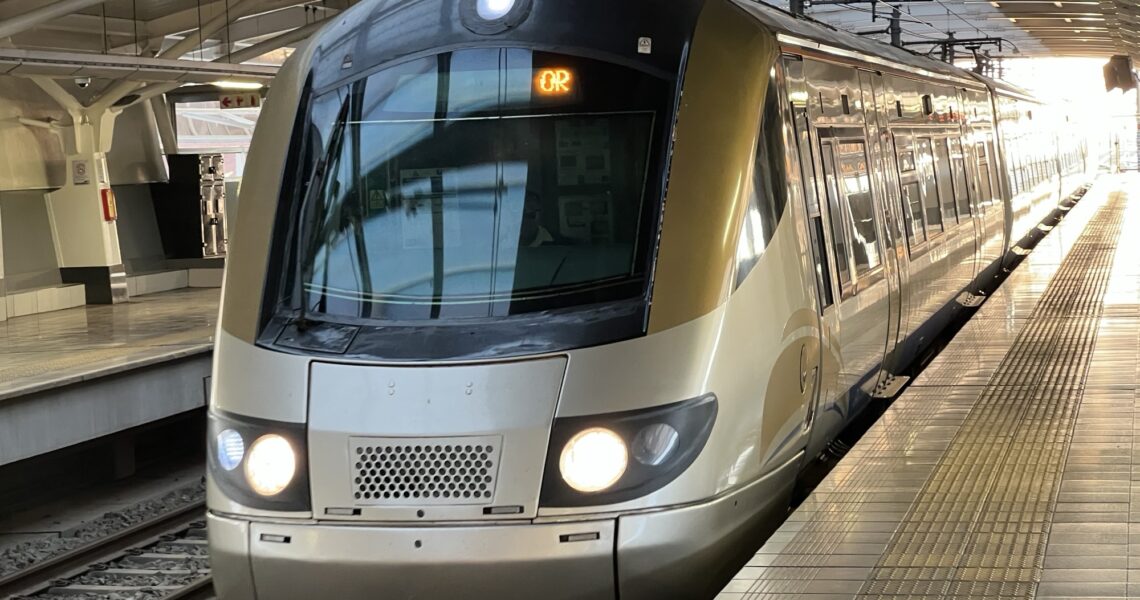
We walked through a slightly more modern area, with more westernized buildings, and busy traffic circles. There were shoe shiners, construction workers, and a surprising amount of soldiers (with rifles), but it didn’t seem like there was any tension around them. Eventually we passed Rabat Ville station and marked it in our memories for tomorrow, and then finally our target restaurant, facing a light rail line with very modern train cars. 

Outside the restaurant there was a bouncer, definitely a bad sign, but we went in anyway, and there was a really weird vibe. More of a bar than a restaurant, the room was dark and some live music was playing in the corner. All the patrons were old guys, drinking beers served in buckets. A cleaning lady looked up at us but turned her head away, and nobody approached us to see what we wanted. I was guessing that Google was out of date on this one. With everyone still watching us curiously we ducked out.

An emergency Google session led us to another restaurant nearby. This one was pretty touristy but we were getting hungry and thought it was best just to sit down and eat. We got a table outside and it was a good place to watch people walk by – and it was interesting that those people watched us just as much as we watched them. One lady even said “Bon appetit!” as she walked by.

Our waiter gave us menus and said that he didn’t speak English but asked if we spoke Spanish. I responded in Spanish and thought we’d be OK, but I guess my response wasn’t very clear because a new waiter came next and handled everything in English. We drank some juices (no booze on the menu) and Kuniko’s avocado “juice” was a big hit – it was blended with milk and so creamy… wow!

We had some couscous and pfasa. The pfasa seemed similar to what we ate at Aida’s place, but according to locals it was a different dish. The food was good – not as spicy as I expected, but tasty. There certainly was a lot of food there – we probably could have split one dish and been OK, but it is good to try various things.

We finished with some mint tea and paid the bill – a little pricey (180 MAD) but we were happy to fill our bellies. Walking back to our hotel the streets seemed a little busier now, and this time we saw more stray dogs to go with all the stray cats. The street now had lot of food stands open, but most of them were pizza, burgers, fried snacks and so we didn’t feel like we would have wanted to go there anyway. 

Back at the hotel we were pretty tired and went to bed super early, still trying to get equalized with the exhaustion and jet lag. The neighbors came to their room a bit loudly, but we couldn’t really complain as we were in bed by 6:30 pm. We were eager to get on a train and see more of the country tomorrow.

Day 1 and 2 – Osaka, Istanbul, Casablanca and Rabat

As usual our longer trips begin with a very busy schedule wrapping up work before the trip. I had our departure day off, so I could put the finishing touches on our packing, straighten up the house and turn everything off, and then take a leisurely ride by train and bus to the airport.

Kuniko, however, was super busy and had to work even on our day of departure. After work she rushed to the airport using an express train from her job in Osaka. By the time she arrived a pretty good line had formed at the Turkish Airlines counters, and so we waited patiently for things to start to move. 

Turkish had only two counters available, and they had some confusing signage above. One said “Online Check-in” and the other said “Bag Drop”. I had checked in online already and I just wanted to drop our bags – which line should we use? I asked the staff and she pointed us towards the longer of the two lines.

But as we approached the front of the line, Kuniko suddenly felt faint, and as I struggled to hold her up she completely passed out. I guided her slowly to the floor and told her to keep breathing – after about ten seconds she came to. She was still shaky so we got out of line, I got her some water, and we went off to the restrooms to try to freshen up. As I waited outside the women’s restroom for Kuniko, I realized that I had no good way to check on her. The longer it took the more I worried, but eventually I shouted her name from the entrance and she was fine. 

There was a time when we were wondering whether to go on with the trip or to head back and just focus on resting, but ultimately Kuniko said she wanted to do it.

Once Kuniko was feeling a little better we went back to the line and had to wait from the end – it took a long time to get back to the front, but check in was easy and we rushed through security and immigration in time to make our flight. Kuniko bought me some curry bread for dinner, and then we boarded our plane – on our way. I was hoping that what brought Kuniko down was just exhaustion – and spending the next 13 hours on the airplane in the dark seemed like the best way to deal with it.

I guess we were both tired out – we slept through most of the flight. Before sleeping I saw the time remaining clock at 13 hours, and the next time I woke up it said 3 hours. That was a new record for me – and in economy class, too! The only down side was the guy in the seat behind me poking his toes into the back of my elbow now and then – gross… Kuniko got some rest and was feeling much better, and so it seemed like it was the right thing to go through with the trip.

So soon enough we were back in Istanbul airport with lots of time to kill. We had been here a few months ago for our summer trip, and we were wary of the 36 euro prosecco. We did have a couple of coffees at a cafe with a cheese sandwich that really hit the spot – even though it was pretty greasy. We also discovered the airport “NapZone”, and so we got even more rest while stretched out in a very comfortable recliner – nice!

Believe it or not we got hungry again, and went to a sports bar for Turkish kofte, a great cheeseburger, a Turkish sparkling wine (expensive but really good) and an Efes beer (or two).  While enjoying the food we were talking and Kuniko said that our next country will be the sixtieth country that we’ve visited. Wow!

We headed off to the gate, got our boarding passes (which had been changed due to a plane switch). Waiting by the boarding gate a guy across from us was snoring so loud – his family looked embarrassed but didn’t wake him up. It was so loud as to make you worry for his medical condition. 

On the plane we sat next to a nice guy with his family, and ate a dry chicken dish. We did get a bag of Turkish snacks, which came in handy later – I just threw them in my backpack. Kuniko slept through most of the five hour flight to Casablanca – it was a lot of sleep to catch up on. Out the window I could see the southern coast of Europe but unfortunately couldn’t see the rock of Gibraltar – too cloudy or too far away. 

Once we landed at Casablanca we had two events in the tunnel coming off the plane. First, a guy next to me suddenly vomited against the window, and second, there was a group of policemen checking passports at the end of the tunnel. Not sure if these two events were related, but it took a while to get through the tunnel and off to immigration. We picked a long line in immigration and got our first taste of the slow and steady delays that come with a developing country. While we waited the immigration staff frequently looked up from their work to glare at people in line, they sometimes got up and helped other people cut in front of us, and generally worked very, very slowly.

Near us a group of Chinese people came in and were acting really weird – they tried to cut into the front but were sent back to the end of that line. Our line was so slow that we watched the Chinese guys make it all the way the front of their line again – it was another hour before we got through with our passports stamped.

We had a long wait for our suitcase – another hour watching the carousel – until we finally left the airport. We caught a train from the airport – we had considered a taxi to save time but it seemed from the internet that it would take about the same amount of time for a much higher price. So we waited about 20 minutes for a train, and we were off to Casablanca’s main station (Casa Voyageurs) from the airport. Finally! Our train was really old, and it made its way slowly to the station, so by the time we arrived we had missed the next express train to Rabat where we were hoping to spend the night. We instead walked around the station killing time until our train would arrive. The station itself was quite modern and beautiful – all the train stations we saw in Morocco were very nice. The trains weren’t modern but at least the stations were cool.

Originally our plan was to take a taxi from Casa Voyageurs to see the Hassan mosque, but from our messaging with Aida and her husband Othman it seemed like it would be better to come directly to their place and save the mosque for later. So we caught the next train to Rabat, but we had to change trains at Casa Port via another slow train. Casa Port had lots of people changing trains – some running across the tracks – and the port must have been nearby as there were flocks of seagulls swirling overhead.

The next train was a little bit faster, and in first class we sat alone until a family of four came in and sat right near us. The kids were super noisy, the parents let them scream and yell, and it seemed like the air conditioner was stuck on the maximum setting so we were really cold. It was turning into a real ordeal – poor Kuniko pulled her hood over her head and just sort of checked out. 

Finally a staff member noticed the cooler was not set correctly and fixed it. The conductor was sitting behind us as we traveled, playing with his smartphone. When he checked our tickets Kuniko had accidentally shown the old ticket, but the conductor didn’t seem to care at all.

Meanwhile I was messaging Othman who was waiting at Rabat station to pick us up. Our train was running about 45 minutes late, and he was nice enough to wait around for us. Finally we arrived, and he took us to his car and got us on the road to La Finca, Aida’s facility/home in the countryside. It took another 45 minutes or so to get there by car, through the darkness and down country roads. Othman was really nice to answer our questions and chat with us – he owns a restaurant, does computer programming, and also helps Aida with La Finca. 

We drove past the king’s residence complete with soldiers out front, and then past a big area of BBQ stations built out of truck trailers – that seemed like a place I’d like to try out. Then we went down a dirt road and finally arrived at La Finca.

Othman used a remote control to open a gate, some dogs came out from inside barking (and sometimes growling at each other), and then we could finally get our stuff inside. We kicked off our shoes at the door and had a chance to greet Aida, and meet some of her friends that were also there for dinner. Luckily they are used to eating late, but we felt bad for making everyone sit around while we tried to manage the Moroccan train system.

There was a big group there – we met Shashi and Nastya who gave us lots of information on places we should go and foods we should try. Also there was Aida’s friend Nassim with her daughter Kiana, who spoke English with us and made us feel welcome. Nassim was really into Japan after her stay there, and she was also friends with Pico Iyer which was pretty surprising. Also there was Zineb (Aida’s cousin) and Imane (Aida’s friend) and their kids: Adam, Yanis, and Ilyan. Mostly they spoke French, so we didn’t get a chance to talk much. 

Aida welcomed us with dates and milk as a Moroccan traditional greeting, and then gathered us all into a circle to welcome everyone together, and in a very kind gesture she spoke in English to help us out. She also made a big announcement that caught everyone by surprise, and so it was an even more special evening. Afterwards they served a real feast – Moroccan flatbreads cut into paper thin strips (like kottu roti) and served with lentils and a big roast chicken on top. There was also nettle soup, cucumbers with sesame oil (to give a refreshing Asian splash). She also served a really nice salad that was so light that I felt like I could eat it endlessly. 

Everyone was talking and eating around a long table inside the very big house, and we struggled a little to follow all the languages being spoken. Still, everyone made us feel welcome and chatted with us, even though at this point we were totally shattered from the long travel day. 

Dessert was an excellent lemon cake, I had lots of great wine, and after some cookies came out on a plate it was time to call it a night, at least for us. We begged off to bed, Aida gave us a big bottle of water for hydration, and we retired upstairs to our room. It was a huge place and each group had their own bedroom and bathroom – so spacious. 

We pretty much just conked right out – one of our longest travel days ever. If the party went on downstairs without us, we were both completely unaware. What a day!

Books: Glass Houses by Madeline Ashby

This book hooked me with the premise but soon careened off into a new direction and ended with something out of an old James Bond movie. I was prepared to accept the story in the beginning, but soon the plot became more and more ridiculous. The story is full of technology and tech bros, and a scary future that supposedly will happen if we continue down the road that we are on. It would have been nice to see this rather than it being told to us – the conversations about these issues were superficial and told in passing rather than being thoughtful about it.

The characters start off reasonably but they soon jump off the rails, too. The more I write here about the book the less I feel like it was worth the time to read. Hopefully my next book can get me back on track.

Next is The Little Drummer Girl by John Le Carre.

Books: The God of the Woods by Liz Moore

This book was a pleasure to read. Starting out from a summer camp crisis, it spirals into a big web of connections over several generations of people. The focus of the book is on the differences between the people who have money and the townies that are there to earn it.

Part of the fun for me was discovering the connections between characters, and guessing at who, where and when. The book jumps frequently between several time frames, the most recent of which is 1975. Sometimes the jumps seemed to be happening too quickly and it was hard to follow a specific character’s track, but the author included a small indicator at the start of each chapter to show where you were in the timeline, and I thought it was an elegant solution.

Speaking of 1975, the book made sure to point out some of the ways that women had it worse back then. I couldn’t help but remember the Phillip morris magnets on my parent’s refrigerator when I was growing up: You’ve Come A Long Way, Baby! The book is largely female-centric, and it is the female characters that largely drive the story and overcome obstacles. I’m fine with girl power type books, but occasionally it does feel a little out of balance.

But the author did a great job of laying out a complex story across several timelines and brought it all to a very satisfying resolution. It was a very entertaining reading experience.

Next I am reading Glass Houses by Madeline Ashby.

Books: The Wide Wide Sea by Hampton Sides

It was a total coincidence that I read this book so close to the book on Shackleton exploring Antarctica in the early 1900’s. These two events are separated by 130 years, and it was fun to see what the differences were between the two.

This book describes the third (and final) expedition of James Cook during an age of exploration – the world was yet to be mapped and there were still big blank areas out there. It is hard to imagine what life might have been like when you didn’t know what was across the sea. Cook’s voyage made first contact with several native peoples, and he carried out the goofy imperialistic ceremonies to claim these people and their land as property of the British Crown.

The examination of imperialism and native issues is nicely handled, and the author seemed to have done his research to get a native perspective where possible. He even pokes fun at the British crew of long ago – how they reported (again and again) the sexual prowess of the native women of Tahiti and Hawaii – by noting that there was no evidence of similar comments regarding the British sailors’ prowess passed down through history.

While telling the story I sometimes got the feeling that the author wasn’t entirely neutral in this, so I think it is important (as with any history book) to read this with a grain or two of salt. The book was quite long and described the journey in detail – some might think it was overlong but I liked this aspect.

Two extra things I got from this book – learning about an American on board who was impressed into the British marines. John Ledyard spent three years on this voyage, and once it was over:

“…he embarked on a trek of more than six thousand miles, mostly on foot, across Europe and Russia in an attempt to reach Alaska, but he was arrested in Siberia under orders from Catherine the Great. Ledyard died in Cairo in 1788, aged thirty-seven, while preparing an expedition to search for the source of the Niger River.”

It seemed like there was a lot of exploration going on at the time and that some people just lived on a grander scale.

The second extra thing I enjoyed was the artwork that was included – sketches and paintings by members of the voyage that showed these far off destinations to readers back in England. The style and detail were especially captivating for me.

Probably the best thing about this book was that I read it in ignorance of the result of the expedition. Either I didn’t know or forgot what happened during this historical voyage, and thanks to my cluelessness the book was that much better.

Next I am reading The God of the Woods by Liz Moore.

Books: Open by Andre Agassi

I am not a big fan of tennis, but I heard that this biography was worth reading even for people like me who know little about the game. I do remember (vaguely) the presence of Agassi in the media when I was growing up, and some of these stories rang bells for me.

This book was extremely well-written, and does a great job of describing Agassi’s tennis career, and how he got started, kept it going, and left it. It is mixed with episodes and anecdotes from his life at the time, and it was interesting to read what things he felt were important to relate.

It is easy to get caught up in the story of his tennis career, but I think that hardcore tennis fans might have actually seen the matches that he describes which would be way more interesting for them. Sometimes matches are described in great detail, others just a quick sentence or two, but it seems like he felt nearly every one should be included, which occasionally felt repetitive to me.

There is enough writing about what happened between the big tennis matches to keep the reader interested. It is also an interesting snapshot of the pre-internet world of celebrity tennis.

It was a long book but I got enough out of it to be glad that I read it. Next I am reading The Wide Wide Sea by Hampton Sides.

Books: I Who Have Never Known Men by Jacqueline Harpman

This was a semi-surreal story in an empty setting which is hard to categorize. That is a good thing as far as I am concerned – and I enjoyed this book because it was so different from conventional format books that I often read.

At first the story seems small and simple, and even though you don’t have answers, at least you can feel the tension of the situation and you trust the author to guide you. Slowly you realize that this setting is not actually the world that you know – the tether is there but it is frayed and could break at any time.

And I liked that the author made it clear up front that there are no answers to some of the big questions that come up. I think that kind of honesty is necessary to do what the writer is trying to do. But as soon as we know that answers are not forthcoming, and things are not going according to the rules we consciously and unconsciously know – it feels like anything can happen. Including a great deal of introspection.

There are a lot of haunting scenes – places devoid of people and vast empty spaces. I also go for this kind of stuff in books so I was extremely satisfied to find so much of that here. Where can I find more of this?

My only criticisms are that I felt the sections of the story are oddly divided. As we open up to this new reality there are phases that are described, but the time spent in each one felt out of balance to me.

I really enjoyed this odd duck of a book – it nicely broke up the style of reading I’ve been doing lately.

Next I am reading Open by Andre Agassi.

Books: The Suspect by L.R. Wright

This is a small town murder mystery with an interesting twist – we can follow both the detective and the suspect, knowing more than each one does while trying to connect the dots ourselves.

But it seems like the main goal of this book is to introduce a place, and the people that live there. Characters and locations are introduced, there is a lot about gardening, books, and a local library. I felt like the writer was trying to make a cozy environment, and it seems like there are six other books after this one set in the the same place, so I guess it worked.

I’m not sure I liked the main character – the detective – in this book. He has some stereotypical cop qualities (divorced, can’t make a relationship work, burned out from life in the big city) and he seems quick to anger in a very relaxed and cozy little town.

The writing is quite good, though, and it often describes scents and nature – with a special emphasis on gardening and plants.

The murder mystery itself wasn’t a big surprise – more an exercise in seeing these people in their natural environment and getting to know them.

In the end I think I enjoyed this book somewhat – I’m not sure if I’ll continue the series or not but if the next book comes up at the library and I’m between books, I guess I’d pick it up.

Next I am reading I Who Have Never Known Men by Jacqueline Harpman.

Books: Endurance by Alfred Lansing

Despite enjoying books on travel I haven’t read much on the age of exploration, partly because I’m not sure I trust historical accounts that may gloss over inconvenient information. But this book has maybe shifted my opinion a bit and I’ll keep my eyes open for more on this age.

The book chronicles the unsuccessful attempt of Ernest Shackleton to cross the Antarctic continent, but ends up following a much more dangerous journey to survive. The author uses the diaries and notes of the expedition members to recreate the events, and it feels extremely real, with a slightly dated feeling (the book is about 70 years old).

I really enjoyed reading about the logistics of an expedition of this scale, and what they needed to bring and what they ultimately used. Occasionally the author got caught up in detailing the minute by minute drudgery of what the members suffered through – the idea is to give the reader a sense of their struggle, but I thought towards the end that it felt like a little too much information – at a certain point the details could be dialed down a little to bring the story to a satisfying conclusion.

The biggest enemy of the expedition was the cold – and this book is filled with descriptions of what it is like to suffer – from cold wind, cold water, cold (and wet) sleeping bags, and cold dinner.

The writer seems to make efforts to portray members mostly in a good light. Even one guy who might be seen as a burden on the team is treated with kid gloves. Maybe this is how writers have to deal with subjects that are still alive back in the 50’s. I liked the idea that there were people whose only occupation in life was scrimping and scraping up the money to go out and explore – what a lifestyle! The whole book was a satisfying time travel experience, and I enjoyed it overall.

Next I am reading The Suspect by L.R. Wright.

Books: The Murder of Roger Ackroyd by Agatha Christie

Nice to read something by one of the masters! In my mind I tend to think that books by Agatha Christie are going to be really old and hard to relate to, but despite some of the cultural points most of the book felt modern and interesting even today.

It is hard to express just how clever this book is. It uses our assumptions (that sometimes I didn’t realize I was making) against us, and hides the murderer from us in a fair way. The way the story is written is such that events move quickly, but not so quickly that we are overwhelmed.

If I had to critique something, I would say that because of the situation, there is (necessarily) a lot of smoke to try to see through. Distinguishing the smoke from the fire is the trick here, and in the end I was surprised just how much was camouflage.

This was a great one! Next I am reading Endurance by Alfred Lansing.

Books: A Beautifully Foolish Endeavor by Hank Green

I recently read the first book in this series, and enjoyed it enough to want to try the next one. The first book left you on a cliffhanger, so I was eager to see how it resolved. Unfortunately I couldn’t get into this book, and for the first time in a long time I gave up on a book and didn’t finish.

I hate to write about something that I didn’t finish – it doesn’t seem fair to critique it not having experienced it in its entirety – but I think I should write about why I didn’t like it here for my future self, just in case I forget why I gave up on the book.

The short version of why I gave up – there is a lot of content in the beginning about the side characters dealing with the loss of another character from the first book. Dealing with the loss and also their own social issues takes up so much of the story that I felt like this was more of a self-help book rather than a science fiction story. The group of people from multiple races each have their own issues with identity (race/gender/sexual/etc), confidence, finance, parents, and so on. They consume huge amounts of social media and deal with fame and when are we going to get to the good stuff?

I guess what I missed was the joy – the joy of unwinding the mystery, and the sense of discovery when they unveil some clue. I wasn’t getting that from this book after dedicating a couple hours of reading – so I decided to move on to something else.]

That something else is The Murder of Roger Ackroyd by Agatha Christie.

Books: Straphanger by Taras Grescoe

This book was a long read on where some key international cities stand on the issue of public transportation. The author travels the world looking firsthand at different approaches to transport, and as a travel writing fan I enjoyed this aspect of the book the most.

The idea in the beginning is to contrast cities that have handled public transport well with those that depend on cars and freeways. But it goes deep into the reasons behind each city’s design, the history that dictated that design, and how it may work out for the future.

The author clearly states at the beginning that they prefer living without a car, and so that point of view certainly carries through the entire journey. While he had his mind made up, I felt like the choir that he was preaching to – one of the nicest things about living where I am now is that I don’t really need a car. Walking to the supermarket or reading books on my train commute are some of the best parts of my day.

Because the author clearly has a lot of passion on the topic the history and detail offered on the history of each city can sometimes go long, and it took me quite a while to finish this book. But I did learn a lot, especially why American cities are mostly car-dependent, and how far they have to go before that changes.

My only real criticism of the book is certainly not the author’s fault – this experience was done about 10 years ago, and I am sure that many things have changed since then. I do hope that someday in the future he’ll go out there and see what happened since his first visit to these destinations.

Next I am reading A Beautifully Foolish Endeavor by Hank Green.

Books: Nettle and Bone by T. Kingfisher

This was a fun, sort of cozy fairy tale that was written in a very efficient style. Thanks to the tight storytelling we get right into the heart of the story, and the cast of characters takes off on their quest.

The book was an easy read, there are some interesting characters and quandaries, and I was satisfied with the resolution. Surprisingly it doesn’t lead into a sequel like so many other books from this genre seem to.

If I had any complaint, it would be that at some points it was just a little too cute, and I felt like there was a very specific target audience that the author had in mind when writing this. I don’t think I was in the target audience, but I enjoyed it nonetheless.

I read this while continuing to read Straphanger by Taras Grescoe. That book is full of statistics and history so it is going a little bit longer than I expected!

Books: James by Percival Everett

I really enjoyed this book and the idea behind it, despite the sometimes dark subject matter. It has been a long time since I read Huck Finn, and it took a while to get back into the character and the situation. The main character of this book, James, has an entirely new (previously hidden) personality and seeing how this works in the alternate reality that the author created was enjoyable.

There are plenty of books looking at the horrors of slavery in the United States, but where this book is different is that it may have a greater effect on a new generation that is even farther separated from this period of history. Having characters speaking in clean and educated English where they so often speak in a different way in older books or movies – it may be a little easier for younger people to empathize with them and see them as humans rather than characters.

The book really packed in a lot of situations, and sometimes I thought that it suffered from being restricted to the timeline of Huckleberry Finn as written by Mark Twain. There was time to explore what was happening to Jim while Huck was having his adventures, but sometimes it felt artificial. But again, it has been a long time since I’ve read the original work and so I’d have to go back and re-read it. And I’m not sure that I’ll see any of the characters in the same way – which I suppose is one of the author’s goals.

Next I am reading Straphanger by Taras Grescoe.