Arrival in Vietnam

It’s almost midnight and Kuniko and I are sitting in the back of a car heading into Hanoi from the airport. I’m undergoing intense short-term culture shock as our driver honks the horn repeatedly, flashes his brights, and swerves into oncoming traffic in order to get past slower cars and scooters. I’ve never seen driving quite like it – kind of like you see in movies when the characters are driving through a war zone.

I had arranged the driver ahead of time with the hotel, and he cheerfully put our luggage in the back of the car before we sped off into the darkness. Now I’m wondering if it was worth a free ride from the airport. We’ve got travel insurance and right now I’m thinking about where the booklet is and if there is a section written in Vietnamese.

Kuniko and I chat in Japanese to make sure he can’t overhear our comments on the safety of our trip, and eventually the car makes its way into a more urban setting. In the cramped streets we move a lot faster than I would have thought was safe, and from the car I watch out the windows as people drinking in small shops and on the street push each other around and stroll across the street, ignoring the constant blaring of our car’s horn. I see trash strewn all over, and people huddle over steaming pots of food and try to sell goods to passersby on the street.

We turn a corner and I’m still watching out the back window as a young woman is drunkenly slapping a young man when the car stops and the driver jumps out and starts unloading our luggage. Kuniko and I look at each other and then get out. People are watching us from the little shops all around us, the car is blocking most of the road, and scooters funnel through the narrow gap while I try to get around to the back and get our luggage. It is total sensory overload, and I manage to remember to look around for our hotel and confirm that it is the right one before the driver can take off. After a wave to the driver we drag our suitcases inside the hotel. It’s nearly one a.m. in the morning.

I had made reservations over the internet months ago, confirmed a week ago, and the hotel guy is telling us now that he doesn’t have a room for tonight but the hotel next door has a room for us. He assures us that the rest of the nights we reserved are still fine, and his buddy from the hotel takes our luggage and leads us next door. We walk past somebody sleeping on blankets on the floor and I try not to stare and then we start climbing stairs in an older building that I would otherwise not recognize as a hotel. The guy takes us to the top of the building, opens a door, gives us the key and leaves. The room is not a nice one. The bathroom has no shower, the light fixtures are falling off the wall and only being supported by the electrical wire. The floor is dirty. The bed is the good news – it seems reasonably clean and we waste little time in huddling up under the blanket and talking over the first night. We’re on the seventh floor and we can still clearly hear the traffic and partying downstairs. Welcome to Vietnam.

Leaving Soon

We had a really nice Christmas this year. It is a busy time around here getting ready for our trip, but we squeezed in a visit to Kuniko’s parents’ house, and had a really nice Christmas party with some friends.

Christmas was a low-key one here – we opened presents in the living room under the Christmas lights on Christmas eve. We got a lot of great gifts from family, and I got Kuniko a siphon coffee maker so we can start to use up all this coffee that we received as year end gifts.

Tomorrow we’re leaving for Vietnam in the evening, and from there until Jan 7th we’ll probably be off the Internet. Once we get back I’ll post lots of pictures and maybe a recap if I can remember it all.

Have a great New Year, and see you in 2008!

End of Year Gifts, Wii Fit

Well, hello there. How’s it going?

For several reasons (including my traditional Survivor Finale internet ban and taking my computer to work for a lesson this week) I’ve been neglecting the blog. Let’s remedy that right now.

The week is rapidly coming to an end, and for me it is really good news because after today and tomorrow I have nothing but vacation until the middle of next month. It will also give me some time to clean up the house for the Christmas party that we’re having, and start packing for our trip.

This week I have all the students doing to same lesson, a very simple Christmas lesson where we make Christmas cards to give to their parents. It is a mind-blower for the kids to find out that there are no New Year’s cards in America, so they are interested in seeing how to make a simple Christmas card. We also play a few games, and look at some pictures (on my computer) of Santa, reindeer, and live Christmas trees. I haven’t seen any Christmas tree farms in this country yet. I distribute Christmas presents to them at the end of the lesson, and they all seem pretty happy with it.

I have yet another new student joining the class. He tried out the lesson last week, and started officially this week. His older sister is one of my students in the junior high school class, and she’s really smart. Right now the boy is a little overwhelmed, but hopefully he’ll catch up quickly. I feel sorry for the kids that jump in mid-stream because of the way the materials are designed.

This holiday the amount of お歳暮 (oseibo) has been out of control. During the middle of the year I received quite a lot of presents from the parents of my students. The tradition of giving gifts to people that have helped you out over the years is (very) slowly fading, but some more traditional parents feel the obligation to send me expensive boxes of cakes, coffee, beer, champagne, chocolates, rice crackers, jam, etc. Kuniko and I are now really just hoping we can finish everything before the expiration dates pass. I’ve been writing thank you notes this week and trying to get them all issued before I leave the country.

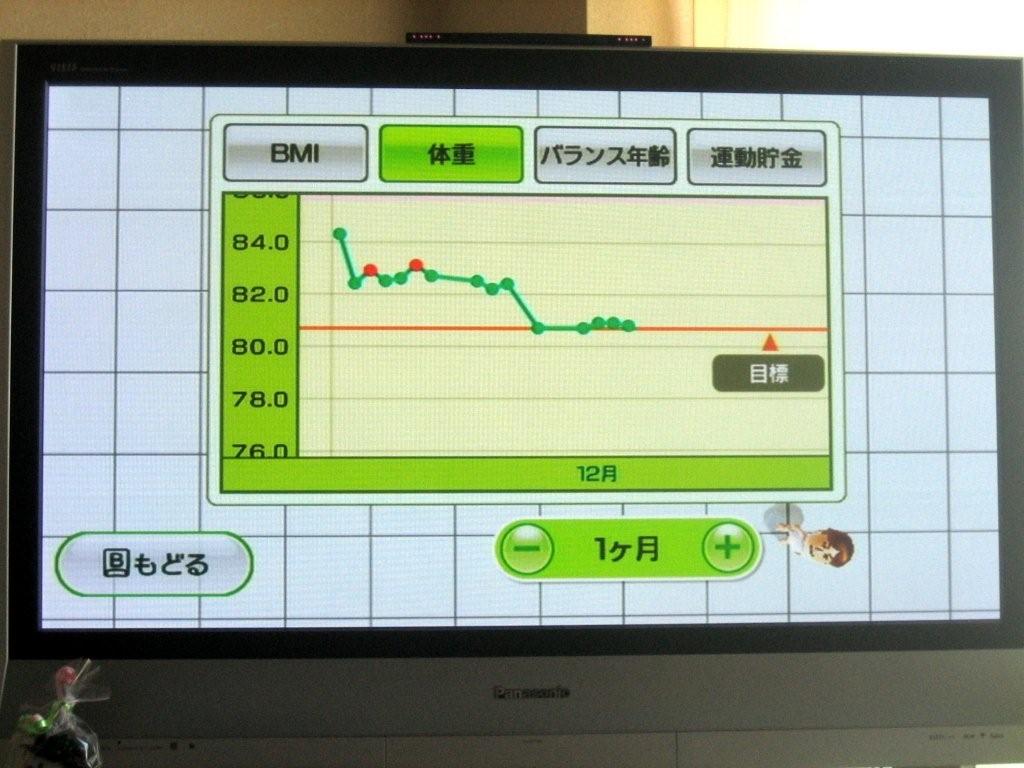
One more thing worth writing about, I’ve been using the Wii Fit balance board and worked it into my daily routine. Every weekday I spend an hour exercising in front of the big screen and build up a pretty good sweat. It is starting to have an effect on my weight, and that is good news. When I started I weighed about 84 kilos (185 pounds), and I weighed in today at 80.5 kilos (177 pounds).

Part of that weight loss was due to the bad chicken episode, so I can’t give Wii Fit all the credit. Still, I feel stronger and have more energy after a morning workout.

The nice thing about the Wii Fit is that it motivates you to push yourself. There are tons of little ways that it does it – it is really well designed. Also it helps with posture by tracking your center of balance all the time. Anyway, so far it has been a great investment and I’ll try to write more about it later on.

Oy

Strike 1 – The chicken was 30% off and I didn’t recognize the cut

Strike 2 – Kuniko came home early so I had to hurry up the soup a bit

Strike 3 – Extra long classes today with two rowdy classes

Did you know the Japanese words for vomiting and sweeping are pronounced the same? That is kinda poetic if you ask me.

Tokyo Trip – Day Two

You can see the first part here.

Nel really rolled out the red carpet in the morning. He was up before me to heat up the bath and make breakfast. Pretty soon it was time to roll out so he saw me off at the bus stop and I headed back to the train station. Hopefully Kuniko and I will be able to come back soon and spend more time with Nel and his family.

The ride back was pretty uneventful, and I was able to remember all the right transfers and stops. I got to the seminar five minutes after it started, but that wasn’t bad considering the distance I traveled through an unfamiliar city.

The speakers during the second day weren’t quite as good as the first day, with the exception of one guy that is famous enough to have written a lot of books and have his own Nintendo DS games. His name was Hideo Kageyama (no relation to my wife) and rather than speaking about English he used his time to discuss the ongoing discussion about whether to go back to a six day school week for Japanese students. He asked the audience whether they were for or against the idea, and I was surprised to see it stand at about half and half. Kageyama sensei kept his speech in pretty neutral territory, but ended up giving a lot of facts comparing Japanese students and their scores with students in other countries. I got the impression that he was against the idea of going back to Saturday school, and instead wanted to look at some other ways to attack the problem of falling academic aptitude.

There was an interesting talk by a lady that had been born and raised in America by Japanese parents, and then moved back to Japan in her 20’s and got married to a Japanese guy and started raising a family. She offered to do her speech in English or Japanese, but ended up mostly using Japanese despite the call from the audience to use English. She had lots of good ideas, and from the English I heard it seemed like it was the language she was more confident in. Every once in a while she would forget a Japanese word (even some words that I knew) and that was interesting to see her work around the holes in her languages. At the end of her presentation she lost a few cards she wanted to use to illustrate a teaching technique, and that brought the presentation to a grinding halt while she looked around for them. Embarrassing.

At the lunchbreak she was talking to Nozaki sensei and when I walked up Nozaki sensei introduced me. She gave me a scary look and asked me what I taught. After thinking a second to try to figure out if this was a trick question, I told her English. She turned bright red and the other teachers laughed. Did I just unintentionally embarrass someone? She asked me what I thought of her Japanese, and again, I had to think a bit to see if there was some hidden meaning. I smiled and told her that I was probably not the most qualified person in the room to comment on her Japanese skills, but I thought her English was superb. She gave me a weird look and left. Nozaki sensei couldn’t figure out what her issue was, and we were puzzling over it the rest of the trip.

During the lunchbreak a lot of the other teachers saw it as a last chance to chat with me, so I spent almost the whole time talking with other teachers, and then it was time to do the second half of the conference. The teachers here did a pretty good job, and I really enjoyed a talk by an older Japanese lady that has been married to an Australian guy for the last 30 years. Her opening theme was to Japanese people to look beyond their borders and experience the world around them. I was struck by this theme, and afterward went up to talk a little with her about it. I started the conversation in English (since she’s an English teacher and has been married to a native English speaker for 30 years) but I was surprised when she stuck to Japanese and avoided English.

Finally the conference wrapped up, and saying goodbye to a lot of people I joined Nozaki sensei and Miki sensei who were waiting for me down in the lobby. We caught a local train from Shinjuku to Tokyo station with about 30 minutes to spare before the shinkansen train back to Nishi Akashi. That gave us lots of time to do some omiyage shopping and to buy some ekiben (駅弁) for the ride home.

Ekiben is kind of a new thing for me – I don’t ride the shinkansen much. Eki means station, and ben is from the word bentou (弁当), meaning a box of food you buy at the station. Japan is a train society, and each station in Japan is renown for various local delicacies available in ekiben form. A train from Hokkaido might specialize in crab or ikura ekiben, and trains from Akashi have specialties involving octopus. I was surprised to find out that since Tokyo is the center of Japan, there isn’t a particular specialty available. I ended up getting a chinese style ekiben with shumai, fried chicken, fried rice, and a vegetable stir fry. Together with our omiyage we lugged everything onto the shinkansen, relaxed and took off. Goodbye Tokyo!

The ride back again was confortable and we enjoyed eating the ekiben while watching the scenery fly by. We got home around 10 p.m., and Nozaki sensei and Miki sensei took connecting trains from Nishi Akashi while I met Kuniko in the parking lot right there. It was good to see her, and I was glad to come home and relax after walking all over Tokyo.

Tokyo Trip – Day One

I’m back from the conference in Tokyo, tired and glad to be home. It was a great couple of days – I learned a lot, really got a Japanese language workout, made some good contacts, and best of all I got a chance to catch up with some good friends.

Friday I went out to the shinkansen station in Nishi Akashi, and met up with Miki sensei and Nozaki sensei just minutes before our train left. Miki sensei is the teacher that was doing my job before I came along, and she went to the conference last year. I’m not sure if Nozaki sensei was footing the bill or not, but it was great that she could come along – it made it more of a three musketeers adventure.

We spent the three hour journey on the shinkansen in style and comfort. Riding the bullet train is just like an airplane, but with passengers coming and going along the way. We spent the time talking on the way, and I taught them lots of English idioms. It is sometimes hard to explain them (i.e. water under the bridge, “In your face!”), but they are really interesting for them to learn and use. Miki sensei did a really good job throughout the trip using them whenever she could.

Once we arrived in the always busy and mind boggling Tokyo station we caught the Tozai line subway and stayed on that heading east until we got to Minami Funabashi, and then met Nozaki sensei’s sister, who drove us past IKEA to her apartment complex right next to the huge American-style shopping center Lalaport. We had dinner at the shopping center at a Japanese health food restaurant (it was really good) and then came back to hang out with Nozaki sensei’s sister and her husband. They really put on the Japanese style hospitality, offering anything and everything they had, and we spent a lot of time saying “no thank you” after filling up on snacks and wine.

One interesting thing was that the husband was really easy for me to understand, compared to conversations I have in my area with older men who can be completely unintelligible. The region of Tokyo is the “standard” dialect of Japanese, and exactly the dialect I learned from my textbook and from my classes back in San Diego. I was amazed how clear everything sounded. I guess learning in the Kobe/Osaka area is learning the hard way.

We spent that night in the guest room of the complex. Apparently residents can reserve the room for visiting people (and because of the location right near Tokyo Disneyland I imagine there are a lot of guests) and so we had the rather large Japanese-style accommodations to ourselves. The second night there was a conflict with another guest so we had to seek other accommodations.

The next morning we caught the train going back into Tokyo riding right past Tokyo Disneyland. We found the seminar location in western Shinjuku, through a very beautiful park filled with the tents and camps of homeless people. There aren’t so many homeless people in Japan, but they do tend to gather into camps, especially in big cities. The police are really pretty gentle with them, and I’ve even heard that if a homeless person sets up shop for a certain amount of time in one place, they can legally stay there from then on. Don’t know if that’s a fact, a legend, or a myth, though. The camp we saw looked like it had been there for a long time, and it was pretty clean.

The seminar was put on by the franchising company that makes the learning materials for my students, and every year they gather as many teachers as possible to keep them motivated and bringing in more students (as it is in their own best interests as well). As I came in and sat down with Nozaki sensei and Miki sensei near the front of the room, a couple of things became apparent to almost everyone in the room right away.

First thing, I was the only foreign person in the room. Second, there were only three men in the room besides the owner and vice president of the company. The other 150-200 people in the room were women. As I sat down I was pretty sure I could feel the weight of all those sets of eyes on my back, and I hoped that my dry cleaner had done a good job with the suit I wore.

A quick note: the vast majority of teachers in the company are women, mainly because their husbands work, and the wives can use their proficiency and interest in English to teach younger learners and bring in income on the side, as well as a way to fill the time that they would ordinarily spend watching TV or chatting with their neighbors. The few men that I met at the seminar were coming off of failed business ventures and apparently are a sign of the recent economic hard times in Japan. I don’t know what I was a sign of.

The seminar kicked into gear and the first speaker (the president of the company) was pretty easy for me to understand. I was starting to feel better about the conference being in Japanese. The second speaker was actually an American guy who consults in Tokyo and spoke about how the teachers in the audience can retain the English they have learned. It’s a legitimate concern, because they always need to keep their skills up for their students and to provide value to the company. Also they need credibility when recruiting new students. Parents that have prospective students want to know that the English the students are learning is not broken Japanized English and so these teachers are always studying, testing and looking for opportunities to speak with native speakers of English. Can you see where this is headed?

Anyway, the American guy has been consulting in Japan for the last 30 years (!) and he spoke in lightning fast English, dropping in Japanese words now and then. Nozaki sensei (and everyone else in the room) really liked the style because he could get complex ideas across quickly. I thought the style was a little weird – how are they going to learn the hard words if you don’t use them? Still, he gave an effective presentation. Halfway through he wanted to illustrate that native speakers of English can listen to and identify lots of different sounds at high speeds, so out of the blue he asked me if I was a native speaker, and then invited me up to help him out.

If someone wasn’t aware of me before they certainly were now, and everyone knew my name after I introduced myself onstage. We did a quick exercise that was easy enough and everyone clapped and I retreated to my seat. The speaker asked me to come up again later, and do another exercise, and so by the time the lecture ended everyone knew me quite well.

I spoke a little bit with the lecturer at the break (his name was Robert Hilke) and talked about California and living in Japan. He said he’d look me up next time he was in my area, so we might catch a beer. There is probably a lot of interesting information about life in Japan locked up in his head – a couple of cold beers might be what I need to get the info out.

After a couple more lectures we had an hour to kill before the evening reception/party, so I split off from Nozaki sensei and Miki sensei, and walked Tokyo alone.

Saturday night in the downtown Shinjuku district of Tokyo. It was awesome. I still get chills walking down the wide urban streets with almost no one around. Even on Saturday night it was pretty quiet. I walked around between these huge skyscrapers and through underground walkways and shopping centers, stopping here and there to enjoy the scenery. It was exactly the same area where I stayed when I first came to Japan in 2003 – I walked past the Keio plaza hotel where we all stayed as brand new JET program participants, and then followed my own four year old footsteps to an old Kinko’s where I first blogged about Japan.

After walking around being all 懐かしい I found my way back to the seminar hall and joined the other teachers going inside. They had a standing buffet style thing set up, and lots of beer and wine for everyone to drink. After the big toast everyone started eating and drinking, and I got a chance to meet a lot of people. The company president pulled me aside and talked with me in English, and after that I just kind of switched back and forth between the two languages depending on the confidence of whoever I was talking to. Lots of people were curious about me, and it felt pretty weird to scan a room full of women and have most of them scanning you right back. As more and more alcohol flowed I stayed pretty close to Nozaki sensei and Miki sensei, who acted as kind of gatekeepers for me, and that helped a lot. Seriously, I haven’t felt like this for a long time.

Despite the precautions I still had a handful of business cards and e-mails, an invitation to join a group of pretty wild looking women on a midnight trip to the Roppongi hills for drinking and pictures, and women waiting in the wings with bottles of booze to try and fill up my glass. The more they drank the less inhibitions they had, and the more courage to try out their English with a native speaker. Yikes.

My whole agenda for the party was to try to make an appearance and get out early, because I was planning on staying the night with Nel all the way back in Chiba. As it worked out I didn’t get out as early as I hoped, and it took a rather spirited game of rock-scissors-paper in the front of the room for me to sneak out with my luggage out the back door.

After a 45 minute ride back to Chiba I got off at the Urayasu station and met Nel. It has been a long time since I’ve seen Nel and he looked good. We caught a bus to get to his place, and then I got to see his wife Kiyomi again and meet his new baby girl Amellie. Check out the pictures in the gallery. Amellie was so cute – and once she initially got over the shock of a new person in their home she warmed up to me and we had a good time. Nel and Kiyomi really put out the welcome mat for me, and kept my glass full of Kiyomi’s mother’s homemade plum wine. We took lots of pictures and sat up talking for a long time, and then Kiyomi and Amellie caught a cab to stay at her sister’s place, leaving me and Nel and a big jug of plum wine to talk through the evening before finally crashing out for the night.

To be continued…
Going To Tokyo

This weekend I’m headed out on a business trip to Tokyo with Nozaki sensei. I’ll be staying with her friend or family (I’m not exactly sure which right now) in Shinjuku and also I’ll stay a night with Nel and his family in Chiba. The conference we are attending is sponsored by the company that runs the franchise Nozaki sensei uses for instruction. This might be a good chance to vent all my frustrations with the learning materials, but then again, maybe it isn’t.

I’ll give a full report when I get back!

Tomoko’s Wedding

Hopefully by now you’ve been able to look through the photos from Kuniko’s sister’s wedding. I’ve been too busy lately to write it up but I aim to take care of that now.

The wedding was in Okayama, so we caught a bullet train to get there. It’s about a two hour drive, but we wanted to be able to partake of the alcohol and get there and back quickly, so it was worth the roundtrip ticket. We took a slower bullet train that took about 50 minutes to get there. The good news was that there were plenty of seats in the unreserved car.

Upon arriving in Okayama the first thing we noticed was that it was a lot colder than Akashi. I had never been to Okayama before – the station was huge. There were lots of shops, and we noted the locations of some of the better ones so we could do some omiyage shopping on the way home.

We made our way into the ANA Hotel across the street from the station, and then went upstairs and found the location for the wedding. Most of the guests were milling around, but since we were family we went into the special waiting room that is designed to keep everyone together and easily accessible. Kuniko’s parents and aunts and uncles were already waiting inside. We sat down with them and made small talk. This was only the second time that I had met Kuniko’s aunt, and her husband was a really nice guy. He had a military style flat-top, and was very friendly looking. We had some good conversations in the waiting room, and then pretty soon it was time to head out and do family introductions.

Tomoko’s fiancee, Atsushi, had invited a lot of family, and hence the need for Tomoko to invite a lot of her family. Even though we had eight people there representing the Kageyama clan, Atsushi’s family numbered about thirty people. I guess we’re all family now. The introductions on our side went quickly and smoothly, and on their side took a bit longer but everyone was patient. I’m glad there isn’t a test on remembering names, because I couldn’t remember even one name after the intros.

One side note, throughout the wedding I relied on Kuniko and the other members of the Kageyama clan to help me figure out where to stand and what order we should be in. It can be rather complicated and fairly important to do things in just the right order. Interestingly, most of the time I was given the better position, because in Japan it is men first, women second. I found it interesting because even though Kuniko is related by blood, she was still relegated to a secondary position most of the time. I felt strange taking the good spots.

After the introductions we all went to the chapel for the ceremony. It was a good ceremony, and we really enjoyed the performance from the priest. I think he might have been French, but the ceremony was mostly in English with a lot of Japanese sprinkled in as well. Much like our own wedding ceremony, the priest was not particularly good at either English or Japanese, with amusing (to Kuniko and me) results. We struggled to keep a straight face during some of the speeches, and I think we held up admirably.

Atsushi did a great job as the groom, and throughout the wedding he was clearly a very happy man. He had been dating Tomoko for years (eight, to be exact) before she finally agreed to marriage. You could tell that today was the culmination of a lot of patience and hard work. He has a good sense of humor, and when he almost made a wrong turn at the altar he and I shared a giggle. I know how it feels to be up there trying to remember the steps that you practiced just once a while back.

After the ceremony we showered them with satin flower petals (environmentally friendly!), took some pictures as a wedding group and then some studio shots as a new united family, and then went up to the reception lunch upstairs.

The reception was fun, and I drank lots of beer with Kuniko’s uncle – each of us spent our time pouring each other drinks. The food and entertainment was great, and the speeches were mercifully short. There was a slight breach in protocol when Tomoko’s boss, the principal of her school, mentioned the upcoming second party. Since not everyone is invited to the second party, I guess it was a party foul.

Lots of people from Atsushi’s family came by and said hello, and if they were reticent about having a foreigner in the family they didn’t act it at all. Everyone was really nice, and Atsushi’s father was especially talkative to me and we talked about some of the time he spent in America. He enjoyed his time there.

After the reception was over we headed out and waited for Kuniko’s parents to change out of their dress clothes and into street clothes, and then went for coffee across the street at the station. They had invited us to stick around for dinner, but since we had just eaten a huge lunch and there was a lot of time to kill until dinner we decided to skip it and head home early.

After buying some omiyage for Nozaki sensei and for some of my students we caught the next bullet train out of there and headed home. I bumped into some of my ex-students from Takasago in Himeji, and then finally arrived back in Okubo. Instead of heading straight home we went over to Saty and picked up a Wii Fit in order to burn off some of the calories we just put on.

The wedding was a success, and I thought it went really well. Next stop for Atsushi and Tomoko is Paris for a weeklong honeymoon, and then they’ll be back in town for Christmas and the New Year. I’m looking forward to getting to know some of our new relatives, and hopefully we’ll be able to meet up with them again sometime soon.

Lunch With Carrie

Wednesday I met up with Carrie for lunch in Higashi Kakogawa. I first met Carrie in Tokyo when I arrived with her on the JET program in four years ago. She wrapped up her three years on JET last year and headed home to Seattle, and now she has a job that lets her travel to Japan once a year to interview students that are hoping to study abroad in America.

We had arranged to meet up for some okonomiyaki, and after a few transportation mishaps we found each other and went over to a restaurant that I had found on the internet. The place was a little off the beaten path and looked kind of like a locals type place. We got a lot of attention sitting down in there and the server looked only at Carrie while we ordered which made us both smile. Carrie looks Japanese so everyone was assuming that she would handle the ordering and any translation that might be needed. This hardly ever happens when I’m out with Kuniko, so it was strange to see it here.

As for lunch, it was great. It was tough to eat the food since we were both talking so much, but eventually we got caught up. After lunch we had some suction coffee at a small coffee shop on my walking route to work. Then Carrie was off to Sannomiya and eventually the airport to head home. It was good to see her – she looked happy.

After that it was off to work for me. My students were in a pretty good mood, despite some of them catching colds. These days I have about two students a day missing due to some sort of illness. I found out that I’m on the hook to design the school New Year’s cards this year. I’ll have to dig up my old graphic design skills and dust off Photoshop to come up with something interesting.

Tomorrow it is Christmas shopping with Kuniko after work, and then Friday we’re going to meet in Sannomiya for burgers after work and do some last minute shopping. Saturday is Tomoko’s wedding in Okayama, and Sunday will be a day to relax before jumping back into work. I can’t believe it is almost December already.

Superbad

I downloaded and watched “Superbad” last weekend. I had heard it was a funny movie, and since it will come out in Japan in about ten years I decided to check it out. I hadn’t seen any commercials and knew nothing about the movie.

My short review – it was great. It was like a huge shot of American culture, at a time when I’ve been kind of down on American pop culture. I could see how scenes from the movie would resonate with young people – there was some really funny scenes involving sex, alcohol and law enforcement. Some of the characters reminded me of my own high school days, which were pretty similar to main characters of the movie, except for all the hot girls and booze.

I know I’m late to the party with Superbad, but I’m getting used to it living in Japan.

Present War!

I’ve been teaching English conversation to a high school girl named Yuka three times a month. The pay is good and we just sit around in her bedroom and chat about whatever comes to mind. Her mom is trying to get her up to speed for a year studying abroad in Australia starting at the end of January.

Anyway, we’ve been getting along great, and towards the end of the hour Yuka’s mom comes in and we chat a little bit in Japanese. They give me a ride home to the station and we chat about cars, music, and Australia. I look forward to the lessons, and I’m sorry that they will end next month.

A while back Yuka went to Tokyo for a trip, and so she brought back some omiyage for Kuniko and me – some “Tokyo Banana” cakes. It was my first time eating them and they were delicious. Soon after that I gave them some cakes that Kuniko had bought in Kobe from a new bakery there.

This is one of the tricky parts of Japanese gift giving customs. In my mind, I have returned the gift and now we’re square. However, if the person feels like your gift was of more value than their original gift, then sometimes they will give you another gift. That’s what happened last night during our lesson – Yuka’s mom had traveled to Kyoto recently and brought back some chocolate yatsuhashi for me.

You can see how this can turn into a vicious cycle. Now I feel like I should get them something to thank them for the chocolate yatsuhashi. I’ll probably pick up something small when we go to Okayama next weekend for Tomoko’s wedding. The trick is to get something pretty small, and hopefully they won’t feel the need to return that gift.

I’ve heard that these gift wars can go on for a long time, with neither party wanting to appear cheap and stop giving gifts. Kuniko was the one who originally suggested to slowly draw down the value of the gifts until it stops. We’ll try that out next and see what happens.

In Which Our Author Comments On Suicide And Pocket Money

My students this week are taking a break from the textbook and instead are learning about Thanksgiving and turkeys. In some of my classes I can tell the students are a little burnt out on the text, and I thought this would be a timely break.

Explaining Thanksgiving is a little difficult, especially to 7-10 year olds. They only slightly have a concept of Japanese holidays, most notably New Year’s Day because according to Japanese tradition they tend to receive a packet of money around that time. Also the concept of a bird the size of a turkey is pretty (ahem) hard to swallow.

At the end of the lesson we make our own turkeys using paper cut-outs of our hands as the shape of the bird and then pasting on colorful feathers. The younger students really enjoy the activity, and the older students are pretty creative. It’s a fun lesson.

When I arrived at the train station on the way home, the electronic board that details the coming and going of trains was completely black, something I have never seen before in the last four years of riding trains almost daily in Japan. An announcement over the PA system said that there had been an accident involving a passenger near Hoden station just to the west of Kakogawa. The “accident involving a passenger” is really a code phrase for “somebody jumped in front of a train”.

I’m sure I’ve written before about the remarkable amount of suicides in Japan. People tend to jump in front of trains because they are everywhere, and easily accessible, but hanging is also pretty popular, as well as the running car with the hose from the exhaust pipe. An interesting twist, in a culture where the group is the base unit of measure, suicides recently are more frequently occurring in groups, with members joining clubs on the internet with the intention of taking the final trip with a couple of co-pilots.

Anyway, the jump in front of a train method has the very un-Japanese side effect of causing a whole bunch of problems for everyone up and down the train line waiting to get to work or go home. Last night the announcement said that no trains would be running for 90 minutes, so I went to find a cab outside the station. All the cabs had been taken, so I started walking in the direction of Okubo and eventually hailed one off the road.

It cost me about 3000 yen, but I got home at a reasonable time. The trains were all jammed up at Okubo station, and everybody was waiting around for a ride home there, too. I wasn’t expecting to have to take a taxi home, so I barely had the money to cover the bill and do some shopping for dinner. I think I’m going to have to keep an emergency fund on me for the future… just in case.

Chilling Out, Studies Continue

The weather continues to get colder and colder. As I write this the temperature outside is just 9 degrees Celsius. Kuniko is off to work and I am reading through the introductions and outlines of my new classes. The two classes that I am taking are “Language Testing” and “Online Learning Environments”.

Of all the aspects of learning a foreign language, testing that knowledge holds the least amount of interest for me. Every time that I have taken a test in Japanese or Spanish it was a stressful time, and not exactly a fond memory. When I was creating tests for my high school students at Takasago Minami they tended to be fairly simple affairs that tested only the expressions learned in my class, and even after dreaming up a test you still had the unpleasant burden of grading all those papers. This class is a compulsory course in order to graduate, so I’ve just got to get through it. Come to think of it, the last two courses that I took also fell into the “I have to take this class” rather than “I want to take this class” category.

In contrast to these, and as a kind of reward for grinding through those last two tough courses, I’m taking “Online and Distributed Learning” this term. It looks like an interesting course that is closely aligned with my interests – online and computer assisted learning.

This week will see me getting acquainted with the requirements and environments of the courses. It is also a short week since Friday is a national holiday. Kuniko and I will probably go out to dinner that night to celebrate our 2nd anniversary. The plan is to go back to Tapas – the same place we celebrated last year.

Life In The 50s

While observing Japanese social culture, either by watching TV or talking to people, I’ve noticed striking similarities between Japan in 2007 and America in the 1950’s. Granted I wasn’t around back in the 50’s, but the image of a housewife working away all day while the husband is working in the office is one that I permanently associate with the 50’s.

For all the modern glitz and neon of downtown Tokyo or Osaka, the modern electronics and gadgets that are everywhere, I tend to get a sense of Japan as a reflection of America’s past. It is a slow paced and conservative society. The wife is staying home to raise the family and provide support for the husband. The husband works long hours so that the family will have financial stability into the future.

These days things are changing. Women are ever so slightly edging towards equality with men, men are showing more awareness of the problem, and some people are starting to realize that going to work is not the only way to help your family thrive. Unfortunately, just like all change in Japan it happens at a glacial pace. Part of the reason is that the culture is largely non-confrontational, so change happens like erosion eating away at a mountainside. Another factor is the huge amount of old people in this country. The top heavy population will start to shrink rapidly in the next 10-20 years, but until that happens there are far too many old men in charge maintain their power structure and status quo.

I’m excited about being around in Japan during this shift. Young people today are used to a different lifestyle and their ideas on music, art and design are exciting and unusual. There are more gay and lesbians on television (although they still mostly only attain “freak” status) and the idea that there are other lifestyles and viewpoints out there is a positive sign.

I know to a certain degree I am prescribing culture here, but it is far more enjoyable to follow a race when you’ve got a horse running in it, and I’d like Japan to be a good place to raise kids, boys and girls.